
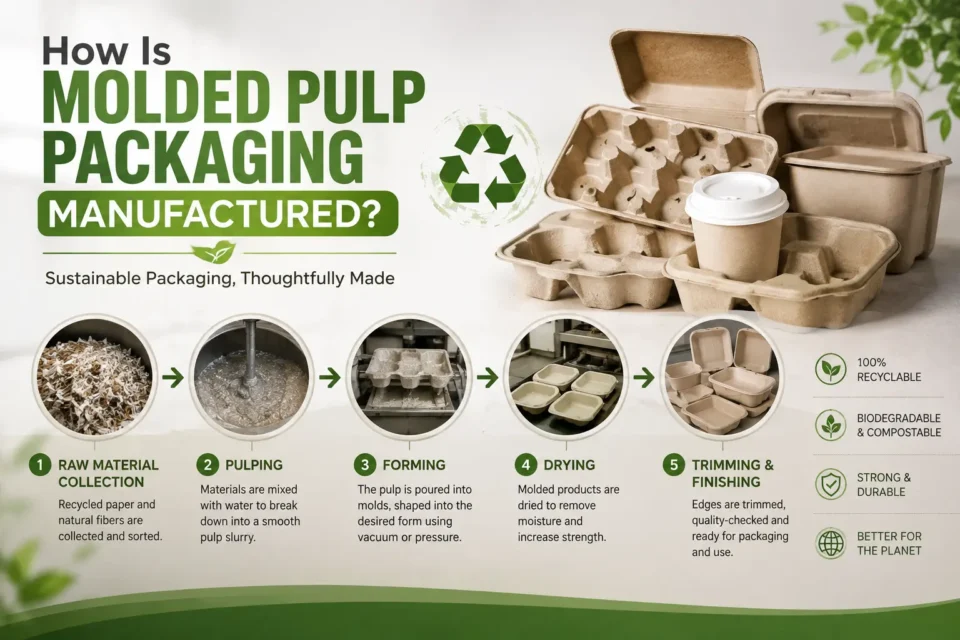
Understanding how molded pulp packaging is actually made is useful whether you’re a curious buyer, a sustainability-focused procurement manager, or someone comparing suppliers. It’s not a simple “pour and dry” process — there are several distinct stages, each affecting the strength, finish, and consistency of the final product. Here’s a complete breakdown.
Step 1: Raw Material Collection and Preparation
Manufacturing starts with sourcing raw material — typically recycled paper, cardboard, and newspaper, sometimes blended with virgin plant fiber for added strength. This material is sorted to remove contaminants like plastic, staples, or other non-fiber waste, then broken down into smaller pieces to prepare it for pulping.
Step 2: Pulping
The prepared raw material is mixed with large volumes of water in a device called a hydra-pulper, which mechanically agitates the mixture until the fibers separate from each other, forming a wet, slurry-like pulp. At this stage, the pulp consistency is adjusted — too thick, and it won’t form properly in the molds; too thin, and the resulting product will be weak or uneven.
Step 3: Mold Forming
This is where molded pulp packaging becomes distinct from regular papermaking. The wet pulp slurry is drawn onto mesh molds shaped like the final product — the individual cavities of an egg tray, the contoured shape of an electronics insert, or any custom design. Vacuum suction pulls water through the mesh, leaving a layer of fiber built up in the shape of the mold. This process is repeated continuously as molds cycle through the machine.
There are generally two forming approaches:
- Transfer molding — pulp is formed on one mold, then transferred to a second mold for final shaping and pressing; this is the standard method for products like egg trays and fruit trays
- Thermoforming — the wet pulp is pressed between heated molds, producing a smoother, more refined, and more dimensionally precise finish, often used for premium retail packaging or precision-fit protective inserts
Step 4: Pressing
Once formed, the wet pulp shape is pressed to remove excess water and compact the fibers, improving rigidity and structural strength. Pressing pressure and duration are calibrated based on the product’s required thickness and durability.
Step 5: Drying
The pressed shapes then move through a drying process — either natural air drying in open-air facilities (common for standard, lower-cost products like basic egg trays) or mechanized heated drying tunnels (used for faster production cycles and more consistent moisture content). Drying time and method significantly affect production speed and, ultimately, cost.
Step 6: Trimming and Finishing
After drying, excess material around the edges of each molded piece is trimmed away, and if needed, additional finishing steps like printing, coating, or surface treatment are applied — particularly for retail-facing products where branding or a smoother finish matters.
Step 7: Quality Control and Inspection
Before packaging and dispatch, finished products go through quality checks for consistency in shape, thickness, strength, and appearance. For export-focused manufacturers, this stage is especially important, since international buyers expect consistent quality across large bulk orders, and defects discovered after shipping are far costlier to resolve than catching them at the factory.
Step 8: Packing and Dispatch
Finished molded pulp products are stacked, packed (often using their own nested structure to save space), and prepared for shipment — whether for domestic delivery or international export, where additional documentation and container-loading considerations come into play.
Custom Mold Design: Where It Gets More Complex
Standard products like egg trays use well-established mold designs refined over decades. But when a business needs custom packaging — say, a precisely shaped insert to protect a specific electronic device or consumer product — the process starts earlier, with mold design and engineering based on the product’s exact dimensions, weight, and fragility. This typically involves:
- Reviewing the product’s specifications and protection requirements
- Designing a mold (often digitally modeled first)
- Producing a prototype mold and sample
- Testing and refining the sample with the buyer before committing to bulk production
This is a more involved process than ordering standard trays off a catalog, which is why custom mold development usually comes with its own lead time and, sometimes, tooling costs — though many manufacturers absorb this into the overall order for sufficiently large quantities.
What Affects Quality in Molded Pulp Manufacturing
A few factors determine whether molded pulp packaging performs well or falls short:
- Fiber quality and blend — the ratio of recycled to virgin fiber affects strength and consistency
- Mold precision — well-engineered molds produce more uniform, structurally sound shapes
- Drying consistency — uneven drying can lead to warping or inconsistent thickness
- Pressing calibration — under-pressed products may be too soft; over-pressed products can become brittle
This is why sourcing from an experienced manufacturer — rather than the cheapest available option — tends to matter more for molded pulp packaging than buyers sometimes expect.
Why This Process Knowledge Helps Buyers
Knowing how molded pulp packaging is actually manufactured helps you ask sharper questions during supplier evaluation — about production capacity, mold-forming method, drying process, and quality control steps — rather than relying solely on price comparisons. It also explains why lead times vary: custom mold development, drying method, and order volume all directly affect how quickly an order can be fulfilled.
At Aavadh Exports, our manufacturing process is built around export-grade consistency — from raw material sourcing through quality control before dispatch. We produce egg trays, electronics packaging, medical and healthcare trays, and footwear and consumer goods packaging, along with custom molded pulp packaging engineered to your product’s exact requirements. To understand the raw material behind this process, see our guide on what molded pulp is.
Frequently Asked Questions
How long does it take to manufacture molded pulp packaging?
Answer: Standard products can often be produced quickly once in regular production, but lead time depends on order volume, drying method, and whether custom mold development is required.
What’s the difference between transfer molding and thermoforming?
Answer: Transfer molding is the standard, more cost-effective method used for products like egg trays, while thermoforming uses heated molds for a smoother, more precise finish, often used for premium or precision-fit packaging.
Can molded pulp packaging be custom designed for my product?
Answer: Yes — manufacturers can design custom molds based on your product’s exact dimensions and protection requirements, typically starting with a sample for approval before bulk production.
Is molded pulp manufacturing environmentally friendly?
Answer: Generally yes, especially when using recycled paper as the primary raw material, since it reduces both plastic use and demand on virgin wood pulp.
Why does quality vary between molded pulp suppliers?
Answer: Differences in fiber quality, mold precision, and process control (pressing and drying) all affect final product consistency, which is why manufacturer experience matters for bulk and export orders.