
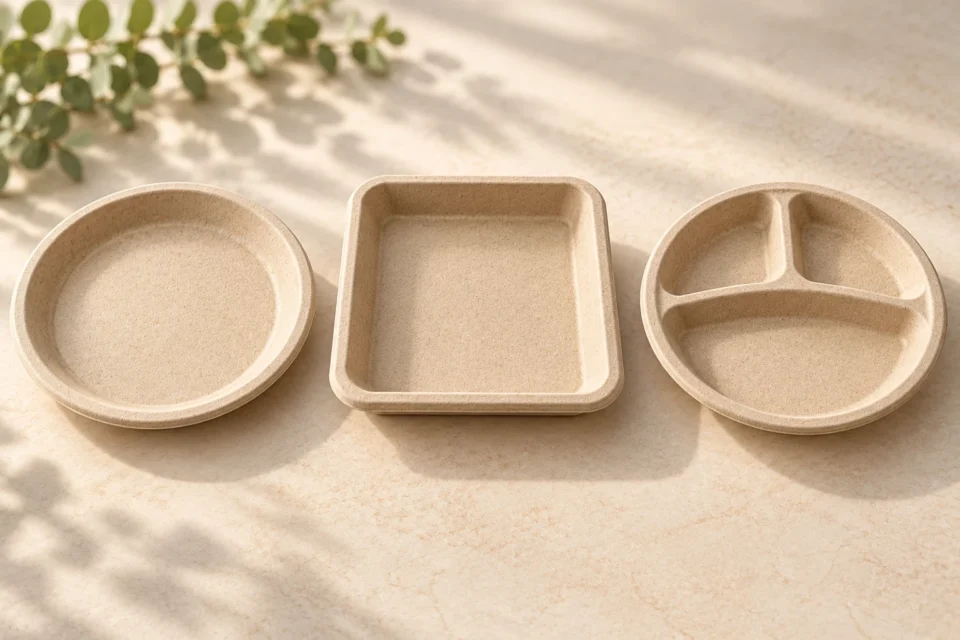
Plate shape affects where food sits and how a complete serving is handled. The best starting point is the meal layout, not the most attractive catalogue photograph.
A bagasse round plate offers an open surface, bagasse square plates provide a different footprint, and compartment plates divide the serving area. Each can suit a particular service arrangement, provided the exact product is appropriate for the food and handling conditions.
Start by mapping the meal
List the main portion, side dishes and sauces. Identify what should remain separate and what can share a surface. Then place the complete serving on a representative sample.
Check whether the food fits inside the usable area without covering the rim. Consider how customers hold the plate and where cutlery or accompaniments will go.
This exercise is more useful than selecting by external dimensions alone. A rim or divider occupies space that may not be obvious in a photograph.
When a round plate works well
A round plate is worth considering when the menu needs an open arrangement. It allows staff to adjust the placement of foods within one continuous serving surface.
Compare the diameter inside the rim, the depth and the space required by your largest portion. If the food extends across the rim, reassess the size rather than assuming a different shape is necessary.
Round plates can also be easier to coordinate visually with round bowls, but appearance should follow the operational requirement. Evaluate a loaded sample during actual handling.
When square plates are worth considering
Square plates can suit arrangements built around rectangular or neatly separated portions. Desserts, snacks and presentation-led menus may benefit from the available layout, depending on the design.
Check the usable corner space. Rounded corners, raised edges and the internal profile change how much of the external footprint can hold food.
Assess how the product sits on trays and counters. If it will be placed inside another package, compare internal and external dimensions carefully; a diagonal measurement is not a substitute for length and width.
When to use compartment plates
Compartment plates create fixed areas for different meal components. They are useful to evaluate when portion separation is part of the serving requirement.
The largest section should fit the main portion without overflow. Smaller sections should suit the sides rather than forcing staff to change portions unpredictably.
Dividers organise the plate, but do not assume they provide a sealed barrier. Test the intended foods and holding conditions, especially where movement during handling could affect the meal layout.
Compare the formats against the same menu
| Decision question | Round | Square | Compartment |
|---|---|---|---|
| Is flexible placement important? | Open layout | Open layout shaped by corners | Fixed sections |
| Must portions remain apart? | Requires careful placement | Requires careful placement | Built-in separation areas |
| Does a specific outer package need to fit? | Check diameter and depth | Check length, width and depth | Check overall footprint and height |
| What must be sampled? | Full loaded serving | Full loaded serving | Every meal component in its section |
This comparison describes layout, not a performance ranking. Strength and food suitability depend on the actual product specification.
Avoid choosing by shape alone
If a sample bends or fails your application, shape may not be the cause. Portion weight, handling, product construction and use conditions all deserve review.
Similarly, a compartment plate that does not fit the meal may need a different layout, not simply a larger outer diameter. Ask for dimensions of the relevant sections where available.
Keep the final range manageable
Choose a clear role for each item. If a round plate and square plate serve the same menu with no practical difference for your operation, consider whether both are necessary.
For bowls and rectangular trays, explore the bagasse tableware guide. Once the shape is selected, use the restaurant and catering guide to introduce it into service.
Discuss the right format with Aavadh Exports
Send your menu type, portion requirements and preferred dimensions to info@aavadhexports.com. Request available round, square or compartment plate options and assess the relevant sample before selecting a format.
Frequently asked questions
Which shape is best for catering?
The appropriate shape depends on the meal layout, portion separation and service method.
Is a compartment plate suitable for every set meal?
Only if its sections fit the actual portions. Test the complete meal.
Do equal external dimensions mean equal serving areas?
No. Rims, corners, depth and dividers affect usable space.

