
A tray that costs less to buy can still cost your poultry farm more by the time the eggs reach the customer. Cracked shells, slow packing, unsuitable cavity sizes and expensive delivery can quickly wipe out a small saving.
Choosing the right egg tray for poultry farm operations starts with a simple question: how do you sell and transport your eggs?
A farm supplying wholesalers in full trays has different requirements from one delivering 15-egg packs to households. This guide compares both formats, explains how to calculate packaging costs and shows what to check before placing a bulk order.
What Is the Difference Between 30-Cavity and 15-Cavity Egg Trays?
A 30-cavity egg tray holds 30 eggs, while a 15-cavity tray holds 15. “Cavity” refers to the individual pocket supporting each egg.
However, capacity alone does not tell you whether a tray will suit your farm. Pocket depth, egg size, support posts and overall dimensions also matter.
Hartmann India, for example, lists different 30-egg trays for different egg-weight ranges. This demonstrates why two trays with the same capacity may serve different packing requirements.
Also clarify whether you need an open tray, a tray with a separate lid or a hinged carton. A 15-egg retail carton and an open 15-cavity tray are different packaging products and should be quoted separately.
| Buying consideration | 30-cavity tray | 15-cavity tray |
|---|---|---|
| Eggs per fully loaded tray | 30 | 15 |
| Useful sales format | Full-tray orders and bulk distribution | Half-tray orders and smaller customer packs |
| Trays needed for 3,000 eggs | 100 | 200 |
| Packing workflow | Fewer individual trays to fill | More trays, but potentially less repacking |
| Main cost question | Delivered cost per 30 eggs | Delivered cost per 15-egg order |
Neither format is automatically the better choice. The right answer depends on your actual order pattern.
When Does a 30-Cavity Egg Tray Make Sense?
A 30-cavity egg tray for poultry farms is a practical option when buyers regularly order eggs in multiples of 30.
Consider this format when:
- Wholesalers collect full trays.
- Packing staff handle large daily volumes.
- Your crates and outer boxes accommodate the selected tray.
- Buyers accept the eggs in the same packaging used at dispatch.
The main advantage is straightforward: fewer trays are required for the same number of eggs.
That may simplify counting and handling, but it does not guarantee lower freight costs. Empty-tray nesting, bundle dimensions and the loaded packing arrangement must also be checked.
For farms searching for bulk egg trays for wholesale distribution, compatibility with existing handling equipment deserves as much attention as the quoted price.
When Is a 15-Cavity Tray More Practical?
A 15-cavity tray deserves consideration when your customers regularly purchase 15 eggs at a time.
For example, a farm delivering household subscriptions may find it easier to pack each order directly into its final delivery format. This can avoid transferring eggs from larger trays before dispatch.
A smaller tray may suit:
- Farm shops selling half-tray quantities.
- Household delivery routes.
- Subscription orders with fixed pack sizes.
- Buyers requesting smaller units for resale.
However, an open tray still needs suitable protection during delivery. Smaller capacity does not remove the need for an outer box, cover or stable transport arrangement.
When comparing 15-cavity egg tray prices, include the complete packaging required to deliver the order.
30-Cavity vs 15-Cavity Egg Tray Cost Comparison
Comparing the price of one tray can be misleading. A larger tray costs more per piece in some quotations but may cost less per egg.
Use this calculation:
Tray cost per egg = Tray purchase price ÷ Number of eggs packed
The following example assumes fully loaded trays and identical egg volumes.
These are hypothetical figures for calculation only. They are not current market quotations or Aavadh Exports prices.
| Cost item | 30-cavity trays | 15-cavity trays |
|---|---|---|
| Eggs to dispatch | 3,000 | 3,000 |
| Trays required | 100 | 200 |
| Assumed purchase price per tray | ₹4.50 | ₹2.75 |
| Total tray purchase cost | ₹450 | ₹550 |
| Tray purchase cost per egg | ₹0.150 | ₹0.183 |
In this example, the 30-cavity format saves ₹100 in tray purchases per 3,000 eggs.
The purchase-price break-even point is also useful. If a 30-cavity tray costs ₹4.50, a comparable 15-cavity tray must cost ₹2.25 to match its tray cost per egg.
That comparison assumes full capacity, equivalent performance and no differences in freight, labour or outer packaging.
Calculate the Cost of Delivering Saleable Eggs
A more useful purchasing measure includes packaging, transport and losses.
Cost per saleable egg = (Egg cost + Packaging + Allocated freight + Packing labour − Recovery value) ÷ Saleable eggs delivered
For a controlled comparison, use the same egg valuation, delivery route and accounting method for both formats.
Suppose one packaging arrangement results in 15 additional unsaleable eggs per 3,000 dispatched. At an assumed egg cost of ₹6 each, that adds ₹90 in lost product cost before considering replacement handling.
Those figures are illustrative. They show how quickly damage can reduce a packaging saving; they do not suggest that either tray size inherently causes more breakage.
Record actual losses during a trial instead of relying on a supplier’s general protection claims.
Five Quality Checks Before Buying Egg Trays in Bulk
1. Check cavity fit with your own eggs
Test small, typical and large eggs from your flock.
Eggs should sit securely without excessive movement or pressure from the surrounding structure. A tray that works for one grade may be unsuitable for another.
This is particularly important when choosing egg packaging for mixed-size poultry farm eggs.
2. Test the complete loaded stack
Place filled trays in the crates or boxes you actually use.
Check alignment, movement and support between layers. Ask the supplier for stacking recommendations and the conditions under which any strength claims were measured.
Do not approve a bulk order based only on how strong an empty tray feels.
3. Inspect consistency
Look for distorted pockets, damaged support posts, loose debris and uneven surfaces.
Compare several trays from the sample batch. Consistent dimensions help staff maintain a predictable packing routine.
Tray weight can be recorded as a quality-control reference, but weight alone does not prove performance.
4. Assess storage and delivery conditions
Explain your storage environment and transport route to the supplier.
If trays may encounter humidity or condensation, request relevant performance information and test samples under representative conditions. Do not assume ordinary molded pulp trays are waterproof.
5. Compare delivered quotations
For a meaningful paper pulp egg tray cost comparison, request:
- Tray capacity and dimensions.
- Intended egg-size range.
- Price at the same order quantity.
- Minimum order quantity and lead time.
- Freight, applicable taxes and outer-packing charges.
- Sample availability and agreed quality requirements.
Compare delivered cost per 1,000 eggs as well as price per tray.
Run a Small Trial Before Choosing Your Format
Test both options on comparable routes before committing to regular supply.
Record packing time, eggs dispatched, damaged eggs received, packaging consumption and customer feedback. Keep vehicle loading and handling as consistent as possible.
A farm serving both wholesalers and households may benefit from using two formats. Full-tray orders can use 30-cavity packaging, while smaller orders can be packed directly into an appropriate 15-egg format.
The decision should follow the order mix and trial results.
Discuss Your Egg Packaging Requirements with Aavadh Exports
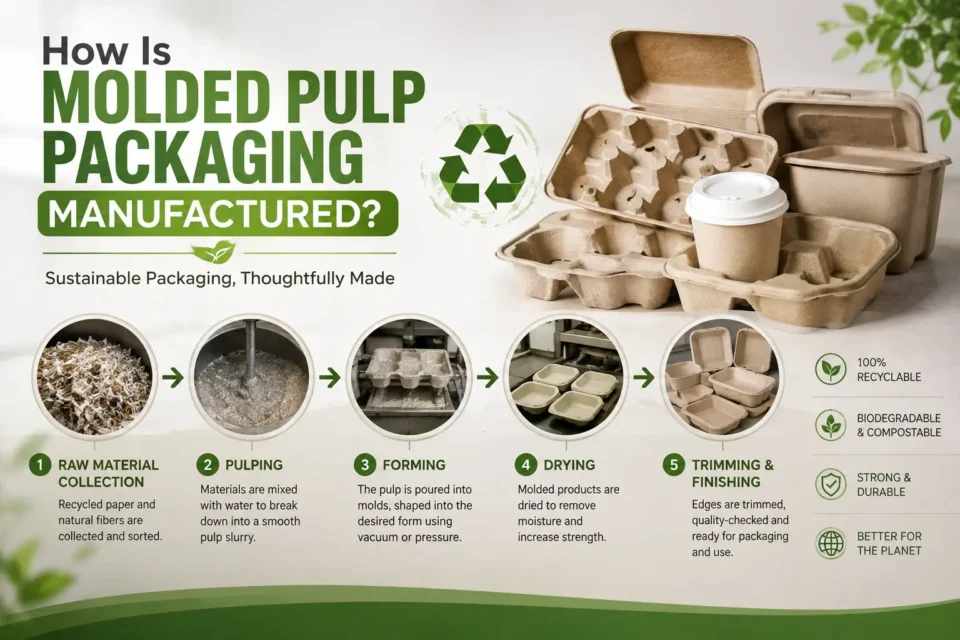
Aavadh Exports manufactures molded pulp packaging, including paper pulp egg trays, and offers sample support based on product requirements.
To discuss a suitable egg tray for poultry farm use, share your egg-size range, monthly quantity, delivery location and packing arrangement. Confirm available cavity formats, specifications and pricing with the team before ordering.
Visit aavadhexports.com or email info@aavadhexports.com with your requirements.
Frequently Asked Questions
Which egg tray is better for a poultry farm: 30-cavity or 15-cavity?
Choose according to your sales format. Compare 30-cavity trays for full-tray wholesale orders and 15-cavity packaging for smaller orders. Validate both through sample testing.
Are 30-cavity egg trays always cheaper per egg?
No. Divide each tray price by its usable capacity, then add freight, packing labour, outer packaging and recorded losses.
How many trays do I need for 3,000 eggs?
You need 100 fully loaded 30-cavity trays or 200 fully loaded 15-cavity trays. Allow separately for spare packaging and partial orders.
Can I cut a 30-cavity tray into two 15-egg trays?
Do not assume this is suitable. Cutting may remove structural support or create unstable edges. Ask for a purpose-designed format or a tray specifically designed to split.
What should I ask an egg tray manufacturer before ordering?
Request dimensions, egg-size compatibility, delivered pricing, sample availability, lead time and relevant performance information. Approve the tray using your own eggs and transport conditions.