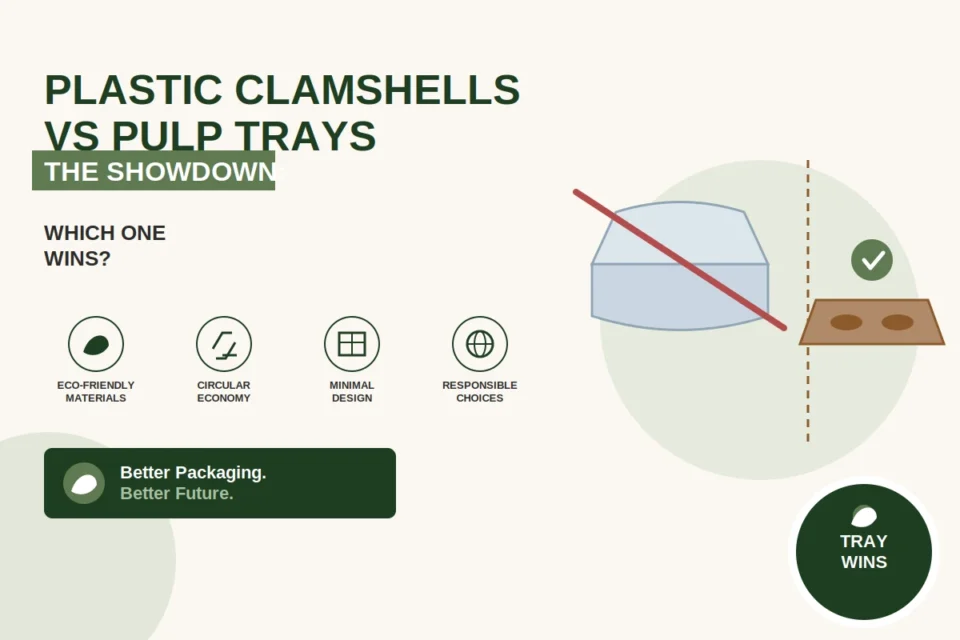
Walk down the produce aisle of most supermarkets and you’ll still see plenty of plastic clamshells — berries, grapes, cherry tomatoes, stone fruit, all sealed under clear plastic. It’s been the default for fresh produce packaging for years, largely because it’s cheap, transparent, and easy to mass-produce. But moulded pulp trays are steadily replacing clamshells across grocery and export supply chains, and the reasons go beyond sustainability optics. This article compares the two on the things that actually matter for a produce business: protection, shelf life, cost, and what retailers and consumers now expect.
The Problem With Plastic Clamshells for Produce
Plastic clamshells solve one problem well — visibility — but create several others that produce distributors deal with constantly:
- Poor breathability- Sealed plastic traps moisture and ethylene gas released by ripening fruit, accelerating spoilage and condensation build-up inside the packaging, which shoppers often read (correctly) as a sign the produce is already going bad.
- Difficult end-of-life- Most clamshells are made from PET or PVC, and even where technically recyclable, they’re frequently rejected by municipal recycling systems due to contamination from food residue or because the specific plastic grade isn’t accepted locally. A large share ends up in landfill regardless of the recyclable label.
- Regulatory exposure- Fresh produce clamshells and trays are explicitly named in several of the packaging regulations taking effect through 2026, including Australia’s state-level PVC and polystyrene phase-outs and the EU’s PPWR requirements on packaging recyclability.
- Rigid, wasteful shape- Clamshells are moulded to a fixed size and don’t compress or nest efficiently, which increases shipping volume and warehouse storage costs relative to the actual product they protect.
None of this means clamshells fail at their basic job — they hold produce and keep it visible. But as an overall packaging solution, the drawbacks have become harder to justify as alternatives have caught up on performance.
How Moulded Pulp Trays Protect Fruit During Transit
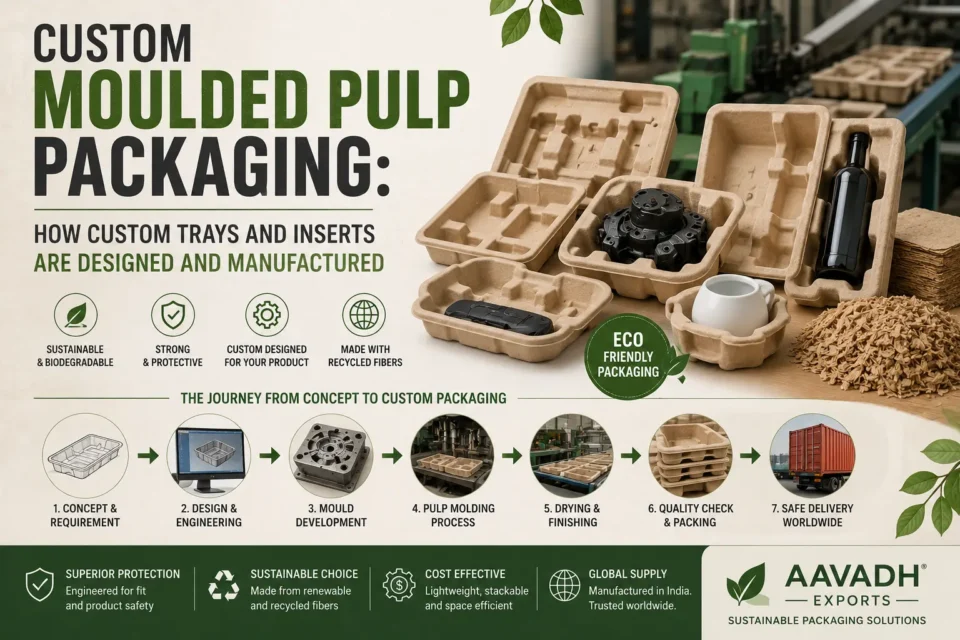
Moulded pulp’s fibrous structure was originally developed for egg protection — arguably the most fragile common food product — which is a useful reference point for how well it performs with produce.
For fruit and vegetables specifically, moulded pulp trays offer:
- Cushioning against impact and compression — the fibre structure absorbs shock during handling and stacking, reducing bruising on soft fruit like peaches, plums, and tomatoes
- Individual cell separation — custom-moulded cavities keep each piece of produce from knocking against its neighbors during transit, similar to how egg trays isolate each egg
- Stacking strength — properly dried and pressed trays hold their shape under the weight of trays stacked above them, important for palletized shipping over long distances
- Consistent surface contact — unlike loose packing, a well-fitted mould supports the fruit’s weight evenly rather than concentrating pressure at a few contact points, which is often what causes bruising in transit
The protection level depends heavily on mould design matching the actual produce dimensions — a generic tray sized for large apples won’t protect smaller stone fruit as well as a cavity sized specifically for that product, which is why many produce packers work with custom mould configurations rather than one-size-fits-all trays.
Breathability & Shelf-Life Considerations
This is where moulded pulp has a genuine structural advantage over sealed plastic clamshells. Pulp is naturally porous, allowing air to circulate around the produce rather than trapping moisture and ethylene gas inside a sealed environment. In practice, this means:
- Less condensation build-up, which reduces the mould and rot risk that sealed plastic packaging can accelerate
- Slower ripening acceleration for ethylene-sensitive produce, since gas isn’t trapped and concentrated inside a sealed shell
- A drier, cleaner-looking product on the shelf, since pulp trays wick excess surface moisture rather than letting it pool
For produce with a naturally short shelf life — soft berries, stone fruit, leafy greens in loose trays — this breathability difference can translate into a meaningfully longer sellable window compared to sealed clamshell packaging, which matters directly for retailer shrinkage rates and, by extension, what they’re willing to reorder.
Cost Comparison at Scale
Clamshell pricing depends heavily on plastic resin costs, which fluctuate with oil markets — a variable that’s largely outside a produce distributor’s control. Moulded pulp pricing, sourced from recycled paper fibre, tends to be comparatively stable and, at high-volume export quantities, is frequently cost-competitive with or cheaper than plastic clamshells once full landed cost is calculated.
There’s also a regulatory cost dimension increasingly worth factoring in: as outlined in packaging regulations taking effect in 2026 across the EU, UK, US states, and Australia, plastic packaging with low recycled content or difficult recyclability is increasingly subject to taxes, EPR fees, or outright restriction — costs that moulded pulp, made from recycled material and fully compostable, generally avoids or minimizes.
For distributors comparing quotes, the practical approach is the same as any packaging sourcing decision: compare full landed cost per unit, including any regulatory fees specific to your market, not just the raw unit price from the supplier.
Retailer & Consumer Sustainability Expectations
Major grocery retailers across the US, UK, Australia, and Singapore have made public sustainability commitments that increasingly shape what packaging they’ll accept from suppliers — plastic clamshell reduction is a specific, named target in many of these commitments, not just a general aspiration.
For produce suppliers, this creates a practical business reason to switch beyond regulation or cost: retailers are actively favoring suppliers who’ve already moved to recyclable, plastic-free packaging formats, particularly for private-label and premium produce lines where sustainability messaging is part of the product positioning. Consumers, for their part, increasingly associate visible plastic packaging on fresh produce with a brand that hasn’t kept up — a perception that moulded pulp’s recognizably paper-based look directly counters.
Which Produce Types Suit Moulded Pulp Best
Moulded pulp performs particularly well for:
- Stone fruit (peaches, plums, apricots) — benefits from cushioning and breathability
- Tomatoes and soft vegetables — individual cell separation reduces bruising
- Citrus and apples — durable enough for stacking-heavy export shipments
- Avocados and similarly weight-sensitive produce — custom cavity depth supports weight without crushing
Very soft berries (strawberries, raspberries) can also move to moulded pulp trays successfully, though these often benefit from a hybrid approach — a pulp tray base with a minimal, vented plastic or compostable film top rather than a fully open pulp tray, depending on how much visual merchandising your retailer requires.
Request a Sample Fruit Tray for Your Product
Aavadh Exports manufactures moulded pulp fruit and produce trays, including custom cell configurations sized for your specific product, for distributors across the USA, UK, Australia, and Singapore. If you’re comparing alternatives to plastic clamshells, we can send samples for you to test against your actual shipping conditions.
Explore Our Products → Get a Quote →
📧 info@aavadhexports.com | 📞 +91 99 50 67 9838