If your business ships eggs, produce, electronics, footwear, or medical supplies, the packaging material you choose isn’t just a cost line — it affects breakage rates, sustainability reporting, regulatory compliance, and increasingly, whether retailers will even stock your product. Plastic and foam packaging have dominated for decades because they’re cheap and easy to mould. But moulded pulp — made from recycled paper fibre — has moved from a niche eco-alternative to a mainstream packaging category, driven by cost pressure and a wave of new regulation landing through 2026.
This guide breaks down how the two materials actually compare, so you can make a sourcing decision based on numbers rather than assumptions.
The Core Difference — Material & Manufacturing
Plastic packaging (including EPS foam, PET clamshells, and injection-moulded trays) starts as petroleum-derived resin, which is melted, moulded under heat and pressure, and cooled into shape. It’s a fast, highly automatable process, which is part of why plastic became the default for so many industries — the per-unit manufacturing cost drops sharply at scale.
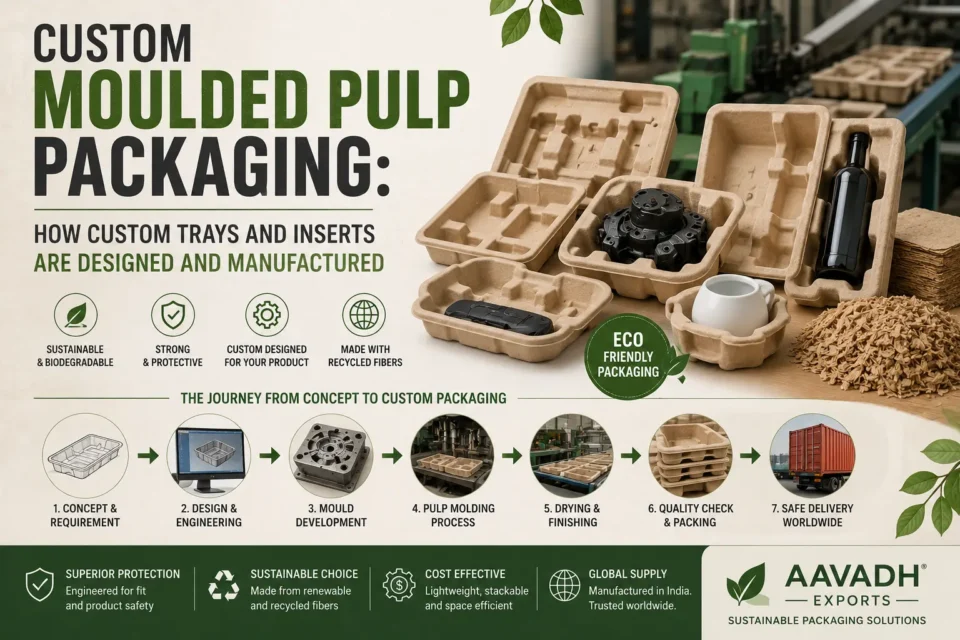
Moulded pulp starts as recycled paper — old newspaper, cardboard, and paper waste — broken into fibre and mixed with water into a slurry. The slurry is drawn onto a mesh mould using suction, pressed to shape, then dried. There’s no petroleum input at any stage, and the finished product is essentially reshaped recycled paper rather than a new synthetic material.
The manufacturing processes are fundamentally different, and that difference is what drives almost every other point of comparison below — cost structure, durability characteristics, and what happens to the product after it’s used.
Cost Comparison — Upfront vs Landed Cost at Scale
This is usually the first question buyers ask, and the honest answer is: it depends on volume and sourcing.
Raw material cost: Recycled paper pulp is generally cheaper than virgin or even recycled plastic resin, particularly as plastic resin prices remain exposed to oil price volatility. Pulp pricing is comparatively stable because the input (waste paper) is abundant and doesn’t track crude oil markets.
Tooling cost: Plastic injection moulding tools are expensive to develop — often tens of thousands of dollars for a custom mould — but produce parts extremely fast once built. Moulded pulp tooling is typically cheaper to develop and faster to modify, which matters if you expect to iterate on tray design.
Landed cost at scale: For high-volume buyers — think container-load orders of egg trays, fruit trays, or industrial packaging — moulded pulp sourced directly from an established manufacturer is frequently cheaper per unit than plastic once you account for the full landed cost (manufacturing, freight, duty). This gap has widened over the past few years as more manufacturing capacity for moulded pulp has come online in Asia, increasing competition and pushing prices down.
Hidden costs to consider on the plastic side: Several US states and international markets now apply packaging-related fees or taxes specifically to plastic (see the regulatory section below), which effectively increases plastic’s landed cost even when the raw material price looks competitive on paper.
The practical takeaway: for standardized, high-volume packaging like egg trays or produce trays, moulded pulp is usually cost-competitive or cheaper at scale. For highly complex, precision-moulded plastic components, plastic can still come out ahead — but for most of the categories businesses are actively switching (food packaging, protective inserts, disposables), pulp is closing or has closed the cost gap.
Durability & Protection — Which Performs Better?
Plastic has real strengths here: it’s rigid, moisture-resistant, and doesn’t lose structural integrity in humid conditions the way an under-dried pulp product might. For applications needing a fully sealed, waterproof barrier, plastic still has an edge.
But for cushioning and shock absorption — which is what most tray and insert applications actually need — moulded pulp performs very well. Its fibrous structure absorbs impact and vibration effectively, which is exactly why it’s been the standard material for egg trays for decades even before the current sustainability push. Quality moulded pulp, properly dried and pressed, holds up through stacking, freight handling, and long-distance shipping without the brittleness that some rigid plastics show in cold conditions.
The honest comparison: plastic wins on moisture resistance in genuinely wet environments; moulded pulp wins on cushioning, stacking strength for dry goods, and consistent protection for fragile items like eggs, fruit, and electronics components. For most packaging use cases — food trays, protective inserts, disposables — moulded pulp meets or exceeds the protection level buyers actually need.
Environmental Impact & End-of-Life
This is where the comparison isn’t close. Plastic packaging, even when technically recyclable, faces major real-world barriers: contamination, inconsistent municipal recycling infrastructure, and low actual recycling rates for many plastic types. A significant share of plastic packaging ends up in landfill or as environmental waste regardless of its theoretical recyclability.
Moulded pulp is made from recycled material to begin with, and it’s both recyclable and compostable at end of life — it breaks down naturally without leaving microplastic residue. For brands and retailers making public sustainability claims, this is a meaningful difference: “made from recycled paper, fully biodegradable” is a claim that holds up to scrutiny in a way that “recyclable plastic” increasingly doesn’t, given how much recyclable plastic is never actually recycled in practice.
This also matters for brand perception. Consumers and B2B buyers alike increasingly favor visibly sustainable packaging, and moulded pulp’s textured, recognizably paper-based look has become a positive sustainability signal in its own right — something plastic packaging, even recycled plastic, doesn’t communicate as clearly at a glance.
Regulatory Pressure Pushing Buyers Toward Pulp
2026 is a genuine inflection point for packaging regulation, and it’s accelerating the shift toward moulded pulp faster than sustainability preferences alone would.
- European Union: The first phase of the EU’s Packaging and Packaging Waste Regulation (PPWR) comes into full effect starting August 2026, tightening requirements around recyclability and restricting certain single-use plastic formats.
- United Kingdom: Extended Producer Responsibility (EPR) rules and the existing Plastic Packaging Tax place a direct cost burden on businesses using non-recycled plastic packaging, with reporting obligations that favor materials like moulded pulp with clear recycled content.
- United States: EPR legislation is expanding on a state-by-state basis, following the lead of states like California, Oregon, and Colorado, gradually shifting the cost of packaging waste management back onto producers who use hard-to-recycle materials.
- Asia-Pacific: China has introduced stricter sustainable packaging requirements, including financial penalties for single-use plastics that don’t meet recyclability or compostability thresholds, while several ASEAN countries are moving toward similar frameworks.
For businesses importing or distributing across any of these regions, this isn’t a future consideration — it’s a near-term compliance cost that makes switching to moulded pulp now more attractive than waiting.
Which Industries Benefit Most From Switching
Not every business needs to switch immediately, but a few categories see the clearest ROI:
- Poultry and egg producers — moulded pulp is already the dominant standard here, and buyers still on plastic or foam are increasingly the exception, not the rule
- Fresh produce distributors — replacing plastic clamshells with moulded pulp trays addresses both cost and the growing retailer pressure to reduce visible plastic
- Electronics manufacturers — moulded fibre inserts are increasingly replacing foam for protecting components during shipping, and this is now the single largest end-use segment globally for moulded fibre packaging
- Footwear brands — shoe inserts are a straightforward, low-risk category to pilot a switch in
- Healthcare and medical suppliers — biodegradable disposables support hospital sustainability targets without compromising hygiene requirements
If your business falls into one of these categories, the business case for switching is generally strongest and fastest to prove out.
Making the Switch — What to Expect
Switching from plastic to moulded pulp is usually simpler than businesses expect, particularly for standardized product categories like trays and inserts:
- Request samples in your exact product dimensions to test protection and fit before committing to volume
- Compare landed cost, not just unit price — freight, duty, and any plastic-specific taxes or EPR fees factor into the real comparison
- Confirm MOQ and lead times with your manufacturer, especially if custom tooling is required
- Run a trial order alongside your existing plastic packaging before fully switching your supply chain
- Plan your sustainability messaging — a switch to recycled, biodegradable packaging is a concrete claim you can use in retailer conversations and consumer-facing sustainability communications
Most businesses that make the switch find the transition takes one or two production cycles to fully validate, after which pulp packaging becomes the default rather than the exception.
Talk to Our Export Team About Switching Your Packaging
Aavadh Exports manufactures moulded pulp packaging — egg trays, fruit trays, cup holders, shoe inserts, medical disposables, and custom industrial packaging — for businesses across the USA, UK, Australia, and Singapore. If you’re evaluating a switch from plastic, we can send samples, walk you through landed cost, and help you plan a trial order.
Explore Our Products → Get a Quote →
📧 info@aavadhexports.com | 📞 +91 99 50 67 9838