If you’ve ever picked up a carton of eggs, chances are the tray holding them was moulded pulp — a material made almost entirely from recycled paper. It looks simple: grey, textured, cushioned. But turning waste paper into a tray strong enough to protect fragile eggs through farms, warehouses, trucks, and supermarket shelves is a precise industrial process with several distinct stages.
At Aavadh Exports, we manufacture egg trays and other moulded pulp packaging at our facility in Jaipur, India, for buyers across the poultry, food, and export industries. This article walks through exactly how the process works — and why understanding it matters if you’re sourcing trays for your own business.
What Are Egg Trays Made Of?
Egg trays are made from moulded pulp — a mixture of recycled paper (typically old newspapers, cardboard, and paper waste) that’s broken down into fibre and reformed into a shaped product. No plastic, no foam, no synthetic binders. The only inputs are water, recycled paper fibre, and in some cases a small amount of natural additive to improve strength or finish.
This is what makes egg trays fully biodegradable and recyclable at the end of their life — they’re essentially recycled paper that’s been given structural shape rather than a new material altogether. It’s also why moulded pulp has become the preferred packaging format for poultry farms and food distributors moving away from plastic and polystyrene foam.
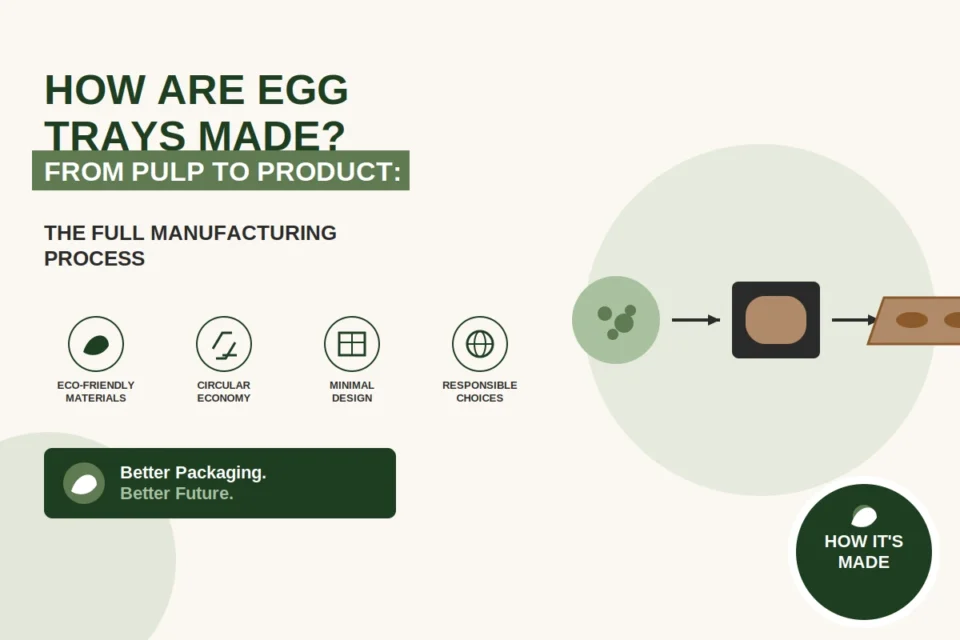
Step 1 — Pulping the Recycled Paper
The process starts with sorting and shredding recycled paper waste, which is then mixed with large volumes of water in a pulping tank. Industrial pulpers break the paper down mechanically until it separates into individual fibres, forming a thick, porridge-like slurry usually diluted to around 3–5% fibre consistency.
At this stage, the pulp is screened to remove contaminants — staples, plastic laminate, tape residue — so the finished tray is clean and consistent. Any additives used to improve strength, colour, or water resistance are blended in during this stage as well.
Step 2 — Moulding & Forming (The Wet-Press Process)
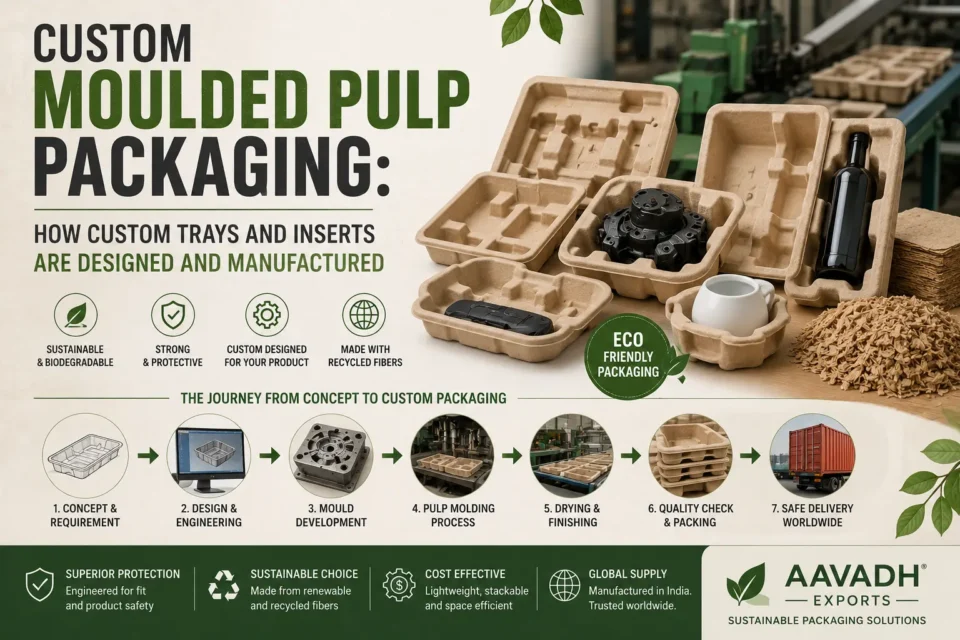
This is where the tray actually takes shape. The diluted pulp slurry is fed into a forming machine fitted with metal moulds shaped like the finished product — in this case, an egg tray with individual cups for each egg.
Suction is applied from behind the mould, pulling water through fine mesh screens and depositing a layer of wet fibre onto the mould’s surface. The thickness of this layer — and therefore the tray’s final strength — is controlled by how long suction is applied and how concentrated the pulp slurry is.
Some manufacturing lines use a second “pressing” mould that compresses the wet fibre against the forming mould, which is what gives moulded pulp its name: wet-press moulding. This pressing step improves surface finish and structural rigidity, which matters for trays that need to stack under weight during transport.
Step 3 — Drying
Once formed, the wet tray still holds a significant amount of moisture — often 60–70% water by weight. It needs to be dried before it’s strong enough to handle, stack, or ship.
Drying is typically done one of two ways:
- Tray drying, where formed trays are placed on racks and passed through a heated tunnel dryer
- Mould drying, where the pulp is dried directly on a heated mould, common in more automated production lines
The drying stage is critical to quality. Trays dried too quickly can warp or crack; trays not dried enough retain moisture that weakens the structure and can encourage mould growth during storage or shipping. Getting this stage right is one of the biggest differentiators between a reliable manufacturer and an inconsistent one.
Step 4 — Trimming, Stacking & Quality Check
After drying, trays go through a trimming process to remove excess material from the edges, giving a clean, uniform shape. From there, trays are visually and physically inspected — checked for consistent wall thickness, no cracking, correct cell depth, and clean edges — before being counted and stacked into bundles ready for packing.
For export orders, this is also the stage where trays are packed into bulk cartons or bales sized for container loading, with attention paid to compression strength so the bottom trays in a stack aren’t crushed during a long sea freight journey.
Why the Manufacturing Process Affects Strength and Shelf Life
Every stage above directly affects how the finished tray performs:
- Pulp consistency and screening determine how clean and strong the fibre bond is
- Suction and pressing time determine wall thickness and rigidity — thin walls mean weaker eggs protection
- Drying control determines whether the tray will hold its shape through humidity, stacking, and long-distance shipping
- Trimming and QC determine whether every tray in a shipment performs consistently, not just the sample you were shown
This is exactly why two “identical-looking” egg trays from different manufacturers can perform very differently once they’re stacked ten-high in a truck or sitting in a humid shipping container for six weeks. The manufacturing discipline behind the tray matters as much as the raw material itself.
How Aavadh Exports Controls Quality at Every Stage
At Aavadh Exports, our production process is built around consistency at each of these steps — from sourcing clean recycled paper stock, to controlling pulp density during forming, to monitoring drying time so every batch leaves the facility at the right moisture level and structural strength. Our manufacturing is aligned with ISO and FSSAI-recognized quality practices, and every batch goes through inspection before export packing.
Because we manufacture for international buyers — including poultry farms, food distributors, and retailers across the USA, UK, Australia, and Singapore — our trays are built to survive not just local handling, but weeks of ocean freight and customs handling before they reach your warehouse.
Looking to Source Egg Trays for Your Business?
Whether you need standard egg trays, custom cell configurations, or bulk container-load quantities, our team can walk you through samples, pricing, and lead times.
Explore Our Products → Get a Quote →
📧 info@aavadhexports.com | 📞 +91 9950679838