If you’re sourcing egg trays for the first time — whether for a poultry farm, a distribution business, or an export order — one of the first questions you’ll run into is: which size and cell configuration do you actually need? It sounds simple, but getting it wrong means either wasted packaging cost (oversized trays for small eggs) or breakage risk (undersized cells that don’t hold eggs securely). This guide covers the standard sizes available, how to choose between them, and when a custom configuration makes more sense.
Why Cell Configuration Matters for Your Order
Cell configuration isn’t just about how many eggs fit on a tray — it directly affects:
- Breakage rates during transit — a cell that’s too shallow or too wide lets eggs shift and knock against each other; too tight, and eggs can crack under pressure while being placed or removed
- Stacking strength — tray design affects how much weight the tray can bear when stacked, which matters for warehouse storage and container loading
- Cost per unit shipped — the right configuration maximizes how many eggs you can pack per container, directly affecting your landed cost per egg
- Compatibility with existing equipment — if you’re supplying into an existing supply chain, your tray size needs to match the customer’s grading, washing, or packing line equipment
Getting this right at the sourcing stage saves you from costly rework or renegotiation later.
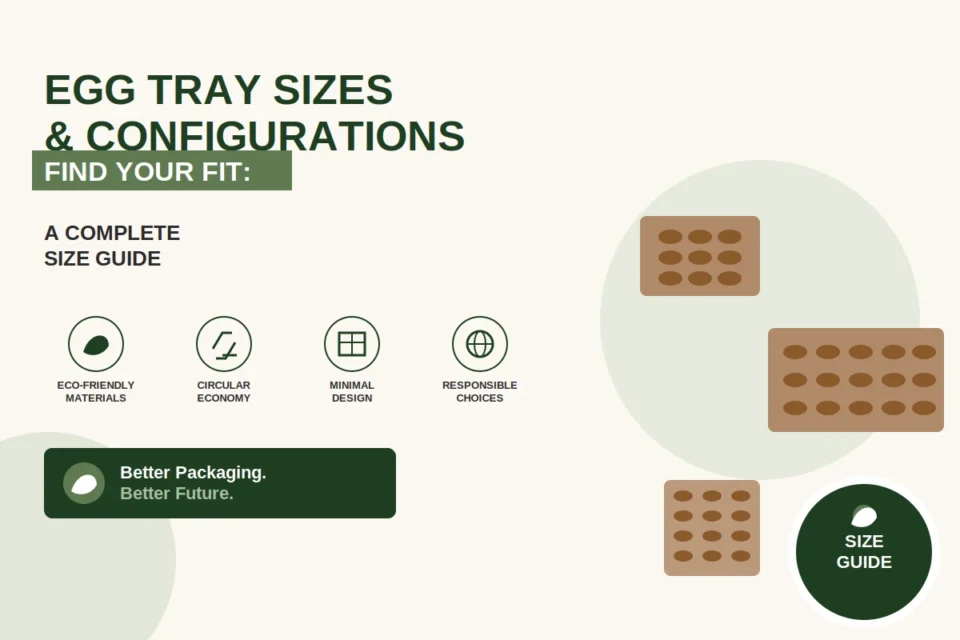
Standard Egg Tray Sizes (6, 12, 18, 30-Cell, and Flats)
6-Cell Trays Small-format trays typically used for retail consumer packs or specialty/premium egg lines (e.g., organic or free-range eggs sold in smaller quantities). Common in supermarket retail rather than bulk distribution.
12-Cell Trays A mid-size retail format, common for standard consumer egg cartons sold directly on supermarket shelves. Less common in bulk/export contexts, more relevant if you’re supplying directly to retail-ready packaging lines.
18-Cell Trays Positioned between retail and bulk formats — used by some regional distributors and smaller wholesale operations that need more than a 12-pack but less than full bulk trays.
30-Cell Trays (Industry Standard for Bulk & Export) The most widely used configuration globally for wholesale, farm-to-distributor, and export packaging — arranged in a 5×6 grid. This is the format most poultry farms and egg exporters default to because it balances handling efficiency, stacking strength, and compatibility with standard palletization and container loading calculations.
Egg Flats Flat trays without raised divider walls, sometimes used for very short-distance transport or as an underlay beneath stacked cartons rather than as the primary protective packaging.
Dimensions & Weight-Bearing by Configuration
While exact dimensions vary slightly by manufacturer and mould design, general sizing principles apply across the industry:
- Cell depth needs to match egg size grade (small, medium, large, extra-large, jumbo) — a cell designed for medium eggs will let large eggs sit too high, increasing breakage risk when trays are stacked
- Wall thickness and spacing between cells affects how much cushioning is provided against neighboring eggs during transit
- Stacking weight tolerance increases with proper drying and pressing during manufacturing (see our guide on how egg trays are made) — a well-manufactured 30-cell tray should reliably support several trays’ worth of weight stacked above it without collapsing
If you’re ordering for a specific egg size grade, always confirm cell depth with your supplier rather than assuming a “standard” tray will fit — this is one of the most common mismatches first-time buyers run into.
Choosing the Right Size for Poultry Farms vs Retail vs Export
Poultry Farms & Egg Producers: Generally default to 30-cell trays for farm-to-distributor movement, since they’re optimized for bulk handling, stacking during storage, and efficient loading onto trucks and into containers.
Retail Distributors: Often need a mix — 12-cell or 6-cell trays for direct consumer shelf packaging, alongside 30-cell trays for their own internal bulk storage and transport before repacking into smaller retail formats.
Export Buyers: Almost universally standardize on 30-cell trays for international shipments, since export costing (container loading, freight calculations, customs documentation) is built around this as the default unit — deviating from it usually complicates logistics without a clear benefit unless there’s a specific market requirement.
Custom Cell Configurations — When You Need Them
Standard configurations cover most use cases, but custom moulds make sense when:
- Your business uses non-standard egg sizes (e.g., quail eggs, duck eggs, or unusually large specialty eggs) that don’t fit standard cell dimensions
- You need branded or embossed trays as part of a retail packaging strategy
- You’re packaging multiple product types together (e.g., eggs plus another item) requiring a non-standard tray layout
- Your existing equipment or supply chain requires a specific non-standard dimension for compatibility
Custom tooling generally requires a higher minimum order quantity than standard trays to justify the mould development cost, so it’s worth confirming your expected order volume can support a custom configuration before committing.
How to Specify Your Requirement When Requesting a Quote
To get an accurate quote quickly, share the following with your supplier upfront:
- Cell count you need (6, 12, 18, 30, or custom)
- Egg size grade the trays need to accommodate (small, medium, large, extra-large)
- Expected order volume (helps determine whether standard or custom tooling makes sense)
- Delivery destination (for export orders, this affects packaging and container-loading recommendations)
- Any branding or custom design requirements
Suppliers with genuine export experience will be able to confirm dimensions, MOQ, and lead time quickly once you’ve provided this — vague or slow answers to these basic specification questions are usually a sign to keep looking.
Frequently Asked Questions
What is the most common egg tray size for export? The 30-cell tray (5×6 configuration) is the global standard for wholesale and export shipments, due to its efficient stacking and container-loading characteristics.
Can egg tray cell size be customized for different egg sizes? Yes — cell depth and diameter can be adjusted through custom mould development to fit smaller (e.g., quail) or larger (e.g., jumbo/duck) eggs that don’t fit standard configurations.
Do 12-cell and 6-cell trays cost more per egg than 30-cell trays? Generally yes, on a per-egg basis, since smaller trays use proportionally more material and packaging per egg housed — bulk 30-cell trays are more cost-efficient for high-volume orders.
Request a Sample in Your Required Configuration
Aavadh Exports manufactures standard 6, 12, 18, and 30-cell egg trays, along with custom cell configurations for non-standard egg sizes and branding requirements. Share your order specifications and our team will confirm pricing, MOQ, and lead time.
Explore Our Products → Get a Quote →
📧 info@aavadhexports.com | 📞 +91 99 50 67 9838