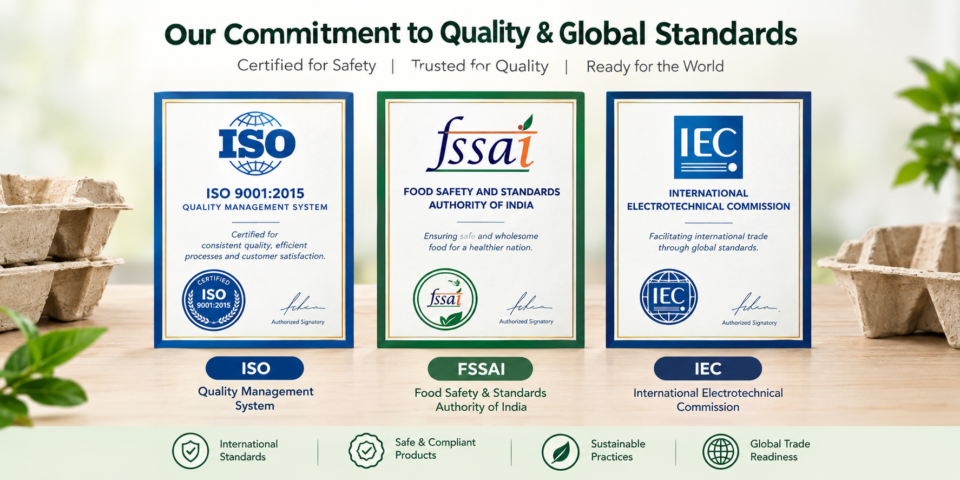
When evaluating an overseas packaging manufacturer, certification badges are often the first thing buyers notice — and the last thing they actually understand. This guide breaks down what ISO, FSSAI, and IEC certifications specifically mean, why they matter for molded pulp packaging buyers, and what questions to ask a supplier beyond simply confirming a certification exists.
ISO Certification: Quality Management, Not a Product Guarantee
ISO (International Organization for Standardization) certifications, most commonly ISO 9001 in a manufacturing context, certify that a company has a documented, consistent quality management system in place — covering process control, defect tracking, corrective action procedures, and continuous improvement practices. It’s important to understand what this does and doesn’t guarantee: ISO 9001 certifies that a company has robust internal processes for maintaining consistent quality, but it does not certify any specific product characteristic (such as strength or moisture resistance) on its own. For a packaging buyer, ISO certification is a meaningful signal that a manufacturer takes process consistency seriously — which matters enormously for bulk, recurring orders where batch-to-batch consistency is critical — but it should be considered alongside product-specific quality verification, such as sample testing, rather than as a substitute for it.
FSSAI: India’s Food Safety Standard, Relevant Beyond Food-Contact Packaging
The Food Safety and Standards Authority of India (FSSAI) regulates food safety standards within India, including for packaging materials that come into direct or indirect contact with food products. For molded pulp packaging buyers, FSSAI certification is most directly relevant to egg trays, fruit trays, and any packaging with food-contact applications, since it indicates the manufacturer meets recognized hygiene and material safety standards for food-adjacent products. Even for buyers sourcing non-food packaging (electronics or industrial applications, for instance), FSSAI certification is a useful proxy indicator of a manufacturer’s broader hygiene and manufacturing discipline, since food safety compliance generally requires tighter facility controls than non-food manufacturing alone would demand.
IEC: Export Licensing, Not Product Quality
The Import Export Code (IEC) is a business registration requirement issued by India’s Directorate General of Foreign Trade, and it is a legal prerequisite for any Indian company engaging in import or export trade — it is not a product quality or safety certification at all. For buyers, IEC registration confirms that a supplier is a legitimate, registered exporter authorized to conduct international trade, which is a basic but important due-diligence check, particularly relevant if you’re evaluating a newer or smaller manufacturer without an extensive trading history.
Why This Distinction Matters for Buyers
A common mistake among first-time importers is treating all certification badges as interchangeable signals of “quality,” without understanding that each certifies something quite different — process consistency (ISO), specific food-contact safety standards (FSSAI), or basic legal trade authorization (IEC). A more useful due-diligence approach is to understand what each certification specifically confirms, then combine that understanding with product-specific verification — requesting samples, checking references from existing export buyers, and reviewing a manufacturer’s stated production capacity against your required order volume.
Certifications as Part of a Broader Trust Framework
Certifications work best as one part of a broader supplier evaluation, alongside sample approval, references, and a clear understanding of a manufacturer’s production process — topics covered in our articles on wet-pressed vs. dry-pressed molded pulp manufacturing and what a pulping mill is and how it works. Buyers new to importing from India specifically may also find our buyer’s guide to importing molded pulp packaging useful for understanding the broader documentation and process landscape beyond certifications alone.
Questions to Ask Beyond “Are You Certified?”
Rather than simply confirming certification badges exist, more useful supplier questions include: can you provide documentation or certificate copies for verification, what specific quality control checks do you perform during production (not just at final inspection), and can you provide references from existing buyers in markets with strict import requirements, such as the EU or Japan, where non-compliant suppliers are typically filtered out more quickly through customs and retailer vetting processes.
Frequently Asked Questions
Q.1 What does ISO 9001 certification actually guarantee?
A: It certifies that a company has a documented, consistent quality management system in place — not any specific product characteristic like strength or moisture resistance on its own.
Q.2 Is FSSAI certification relevant if I’m not buying food-contact packaging?
A: It’s most directly relevant to food-contact products like egg and fruit trays, but it’s also a useful proxy for a manufacturer’s broader hygiene and manufacturing discipline, even for non-food buyers.
Q.3 What is an IEC code, and why does it matter?
A: The Import Export Code is a legal business registration required for any Indian company to trade internationally. It confirms a supplier is a legitimate, registered exporter — it is not a product quality certification.
Q.4 How can I verify a supplier’s certifications are genuine?
A: Ask directly for certificate documentation for verification, and cross-check with the issuing body where possible, rather than relying solely on badges displayed on a website.
Q.5 Are certifications alone enough to trust a new supplier?
A: No — certifications are one part of a broader trust framework. Combine them with sample approval, buyer references, and a clear understanding of the manufacturer’s production process.
Q.6 What other due diligence should I do besides checking certifications?
A: Ask about specific in-process quality control checks (not just final inspection), request references from existing export buyers, and verify production capacity matches your required order volume.
Our Certifications
Aavadh Exports’ manufacturing and export processes are aligned with ISO, FSSAI, IEC, MSME, FIEO, Make in India, and Plastic Free certification standards. Learn more on our About Us page, or contact our team to request certificate documentation as part of your supplier evaluation process.
References
- International Organization for Standardization — ISO 9001 Quality Management: https://www.iso.org/iso-9001-quality-management.html
- Food Safety and Standards Authority of India (FSSAI): https://www.fssai.gov.in
- Directorate General of Foreign Trade, Government of India — Import Export Code (IEC): https://www.dgft.gov.in