
International buyers evaluating a molded pulp packaging manufacturer in India for the first time tend to have the same recurring set of practical questions before committing to an order. This guide answers the most common ones in detail, based on standard industry practice for molded fiber packaging exports.
What Is the Typical Minimum Order Quantity for Molded Pulp Trays?
MOQ depends heavily on whether you need a standard, off-the-shelf tray design or a fully custom-tooled product built specifically for your application. Standard designs, such as generic egg trays, common fruit trays, or standard cup carriers, typically carry a lower MOQ since no new tooling investment is required from the manufacturer’s side, often starting in the range of a few thousand pieces per stock keeping unit. Custom-tooled trays, which require entirely new mold development specific to your product’s dimensions, typically carry a considerably higher MOQ, often reaching tens of thousands of units, in order to justify the tooling investment made on both the manufacturer’s and, in some cases, the buyer’s side. Buyers testing a new market or launching a new product line should specifically ask whether a manufacturer offers a lower trial MOQ option for custom designs before committing to full-scale production volumes that carry significantly more financial risk if the product doesn’t perform as expected.
How Long Does Mold and Tooling Development Take for Custom Designs?
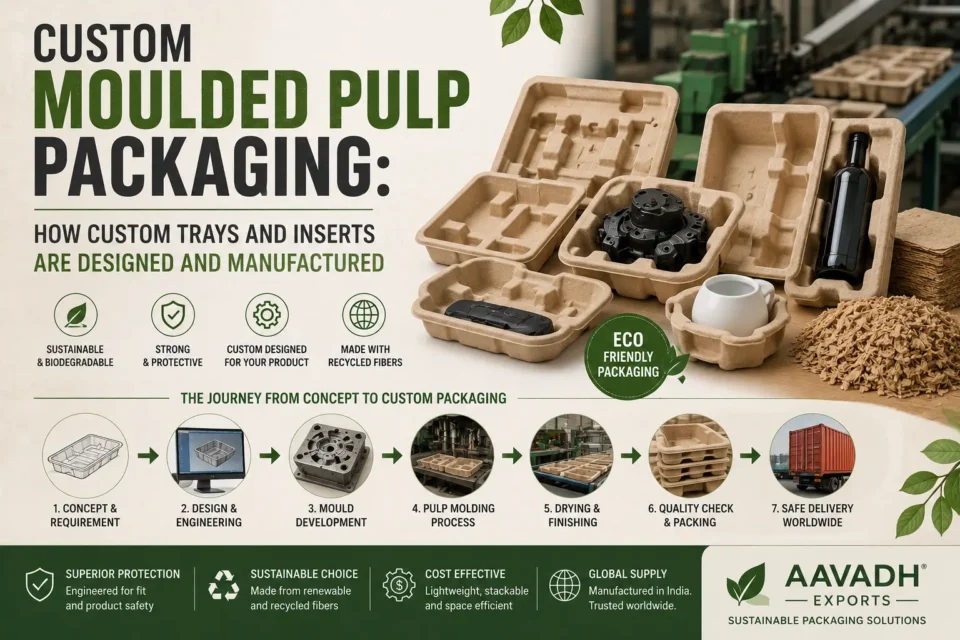
Standard custom tooling timelines typically run three to six weeks from final design approval to the production of the first physical sample, depending on the complexity of the design being developed. Highly precise industrial applications or electronics packaging trays requiring tight dimensional tolerances may extend closer to six to eight weeks given the additional precision engineering required. Buyers should build this realistic timeline into their broader product launch planning process rather than assuming custom packaging can be sourced as quickly as an off-the-shelf standard item, since underestimating this timeline is one of the most common causes of launch delays for buyers new to sourcing custom molded pulp packaging.
What Is the Typical Production Lead Time After Sample Approval?
Once samples have been formally approved and a full purchase order is confirmed, production lead time for bulk orders generally ranges from three to six weeks, depending on the total order volume and whether the manufacturer needs to schedule your production run around other existing commitments already in their pipeline. Buyers working against hard deadlines, such as seasonal product launches or fixed retail shelf placement dates, should confirm actual production slot availability directly with the manufacturer before finalizing tooling arrangements, rather than assuming standard quoted lead times will automatically apply once earlier stages are complete.
How Is Molded Pulp Packaging Typically Shipped Internationally?
Given its relatively low value-to-weight and value-to-volume ratio, molded pulp packaging is almost always shipped via sea freight using standard twenty-foot or forty-foot shipping containers, rather than air freight, in order to keep overall landed costs at a reasonable level relative to the product’s value. Sea transit time varies considerably by destination port, typically running three to four weeks to major European ports, four to five weeks to the United States East Coast, and two to three weeks to Middle East ports from major Indian shipping hubs such as Mundra, Nhava Sheva, or Chennai.
How Is the Packaging Protected From Moisture Damage During Transit?
Reputable exporters use moisture-barrier lining installed inside shipping containers, silica gel or desiccant bags placed strategically throughout the cargo, and carefully planned container loading arrangements designed to maintain adequate ventilation and prevent condensation buildup, which represents a genuine risk for absorbent pulp-based products during long sea transits that often pass through varying climate zones and significant temperature fluctuations. Buyers should specifically confirm what moisture protection measures a given supplier uses before finalizing a shipment, particularly for orders crossing multiple climate zones or extended transit durations exceeding four weeks.
What Incoterms Are Commonly Used for These Shipments?
FOB, or Free on Board, and CIF, or Cost, Insurance, and Freight, are the two most commonly used Incoterms for molded pulp packaging exports originating from India. FOB terms give buyers greater control over freight forwarder selection and the resulting freight cost, since the buyer arranges and pays for shipping from the point the goods are loaded onto the vessel. CIF terms shift the responsibility of arranging freight and insurance coverage to the exporter, which can be a useful option for buyers who don’t yet have an established freight forwarder relationship operating out of India.
Can Orders Be Split Across Multiple Smaller Shipments Instead of One Large Container?
Yes, this is possible, though it does affect overall unit economics. Less than Container Load shipments are available for smaller trial orders but carry a meaningfully higher per-unit freight cost compared to a Full Container Load shipment. Many buyers choose to start their relationship with a smaller LCL trial shipment specifically to validate the packaging within their own supply chain and internal quality processes, before committing to scaling up toward more cost-efficient FCL volumes once the product has been properly validated.
What Happens if a Defect or Quality Issue Is Found After the Shipment Arrives?
This important question should be addressed contractually before placing the first order, rather than being left to informal discussion after a problem has already occurred. Reputable manufacturers will agree in advance to a defined defect tolerance threshold, commonly in the range of one to two percent given the natural material variation inherent to pulp molding, along with a clearly defined resolution process, whether that involves issuing a credit note, providing replacement units in the next scheduled shipment, or offering a partial refund. Buyers should ensure this policy is documented in writing as part of the formal purchase agreement, rather than simply assuming a reasonable resolution will be offered if and when a problem actually arises.
How Far in Advance Should Reorders Be Placed to Avoid Stock Gaps?
Given that production and shipping lead times combined often total eight to twelve weeks on a door-to-door basis for custom products, buyers should plan their reorder timing based on their own inventory consumption rate, with enough built-in buffer to comfortably cover this full cycle without risking a stock-out situation. Many established buyers eventually set up recurring quarterly or monthly purchase schedules with their supplier once a product specification has been fully validated, rather than continuing to reorder reactively only after existing stock has already run critically low, which introduces unnecessary supply chain risk.
What Payment Terms Are Typically Available for New Buyer Relationships?
New buyer relationships commonly begin with a partial advance payment, often in the range of thirty to fifty percent of the order value, with the remaining balance due either before shipment or against shipping documents. As trust and order history build between both parties over subsequent orders, more flexible terms such as documents against payment, documents against acceptance, or in some established relationships, open account terms with agreed credit periods may become available, though this generally develops gradually rather than being offered immediately to a first-time buyer.
Final Note for First-Time Buyers
The biggest risk in sourcing molded pulp packaging internationally is rarely product quality itself, but rather underestimating the combined tooling, production, and shipping lead times when planning around a fixed launch date or seasonal deadline. Buyers who build realistic timelines into their planning from the very start, and who work with a manufacturer that is genuinely transparent about MOQ requirements, lead times, and shipping protocols from the first conversation, consistently experience smoother first orders and develop stronger, more dependable long-term supplier relationships as a result.