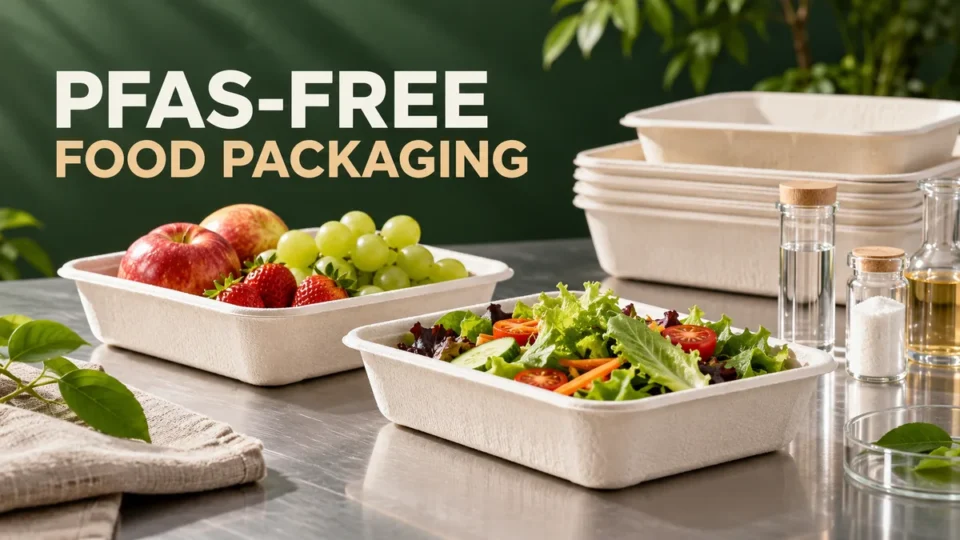
PFAS, often called “forever chemicals”, have become one of the biggest compliance topics in food packaging. For importers of molded pulp trays, bowls, plates and cup carriers, PFAS-free is no longer a marketing extra. In many markets it is fast becoming a legal requirement.
This guide explains what PFAS are, where the rules stand in the USA and EU, and how to check that your supplier’s products are truly PFAS-free.
What Are PFAS?
PFAS stands for per- and polyfluoroalkyl substances, a large family of thousands of synthetic chemicals. They resist heat, water and grease, and they break down extremely slowly in the environment and in the human body. That persistence is why they are called “forever chemicals”. Concerns about health effects and environmental build-up have pushed regulators around the world to act.
Why PFAS Appeared in Fibre Packaging
Molded pulp is naturally absorbent. For hot, wet or oily food, manufacturers sometimes add coatings or additives so that the product resists grease and moisture. Some of these treatments historically used PFAS. This matters most for food service items such as takeaway bowls, plates and clamshells. It matters much less for products like egg trays, fruit trays or industrial inserts, which normally need no such treatment. If you want a refresher on material basics, see what is molded pulp.
The Regulatory Picture
Rules change quickly, so treat this section as an overview and confirm against current official sources before finalising contracts.
European Union
The EU Packaging and Packaging Waste Regulation (PPWR) restricts PFAS in food-contact packaging. Its rules apply from August 2026 and set limits for PFAS in packaging that touches food. The limits cover individual PFAS, the sum of measurable PFAS and total organic fluorine. Packaging that exceeds the limits cannot be placed on the EU market. Some member states, such as France and Denmark, already had their own national rules. For the wider regulatory context, read our guide on EU PPWR and US EPR laws.
United States
There is no single national ban with the same structure, but the direction is clear:
- The FDA worked with industry so that PFAS grease-proofing agents used in food-contact paper are no longer sold for that use.
- Multiple states, including Maine, Minnesota, California, Washington and New York, have restricted PFAS in food packaging. Each has its own scope, definitions and dates.
Because state laws differ, an importer selling nationwide should aim for a product that is PFAS-free everywhere.
Other Markets
Several other countries and regions are also tightening rules. Building PFAS-free into your specification now protects you from future market restrictions and costly redesigns.
“PFAS-Free” Does Not Always Mean the Same Thing
Be careful with vague claims. A supplier may say “PFAS-free” but mean different things:
- No intentionally added PFAS, though trace contamination is still possible
- Below a defined test limit, for example a total fluorine threshold
- No fluorinated chemistry anywhere in the supply chain
These are not equivalent. Ask exactly which definition applies, and ask for the evidence behind it.
How PFAS-Free Molded Pulp Is Made
Fortunately, many molded pulp products need no PFAS at all. Common approaches include:
- Uncoated fibre for dry or non-greasy uses. Egg trays, fruit trays and shoe inserts generally need no barrier coating.
- Denser pressing. Thermoformed products have a smoother, denser surface with better natural resistance. See wet-pressed vs dry-pressed molded pulp.
- Plant-based or mineral-based barriers. Some non-fluorinated coatings give limited grease or water resistance.
- Smart fibre choice. Bagasse and bamboo often perform well in food service applications. See alternative fibres.
Match the level of barrier protection to the real use. A tray holding dry fruit needs far less than a bowl holding hot, oily curry.
Food Contact Compliance Beyond PFAS
PFAS is one item on a longer list. For food-contact molded pulp, importers usually need to consider:
- United States: FDA food-contact requirements for the materials and additives used
- European Union: the framework regulation for food-contact materials and good manufacturing practice rules
- Germany and others: LFGB testing is often requested by European retailers
- Heavy metals and migration limits
- Microbiological and general safety standards
Our guide to understanding ISO, FSSAI and IEC certifications and the article on certifications for paper pulp tray exports will help you read supplier claims correctly.
How to Verify a PFAS-Free Claim
Do not rely on a single sentence in a brochure. Ask for the following:
- A test report from an accredited, independent laboratory. Check the lab’s accreditation and the report date.
- The test method and limit. Total fluorine screening and targeted PFAS analysis measure different things.
- A supplier declaration of compliance. It should name the product, the regulation and the signatory.
- Raw material and additive disclosure. Ask for written confirmation that no fluorinated chemicals are used.
- Batch traceability. You should be able to link a shipment to a specific test report.
It is also wise to run your own periodic spot checks on arriving goods.
Practical Tips for Importers
- Put PFAS-free requirements in the purchase contract, with the test limit and method stated.
- Ask for a fresh test report whenever the recipe, coating or raw material changes.
- Keep documentation for at least as long as your local law requires.
- Plan for retesting if you switch suppliers.
- Use PFAS-free claims in marketing only when you can back them with paperwork.
- Brief your legal or compliance adviser early, before you place large orders.
Common Questions
Are egg trays a PFAS concern? Generally no. Standard egg trays are made from recycled paper pulp without barrier coatings. You should still ask your supplier to confirm this in writing.
Is PFAS-free packaging more expensive? Barrier performance may cost more for demanding uses. For most trays and inserts the difference is small, and non-compliance costs far more.
Does PFAS-free mean compostable? No. Compostability is a separate certification. See biodegradable vs compostable vs recyclable packaging.
Conclusion
PFAS-free is quickly becoming the baseline for food-contact molded pulp in both the USA and the EU. Choose suppliers who can prove compliance with independent test reports and clear declarations, and write the requirement into your contracts. Aavadh Exports can share available documentation and help you select the right product for your application. Contact us with your food-contact requirements and we will guide you.