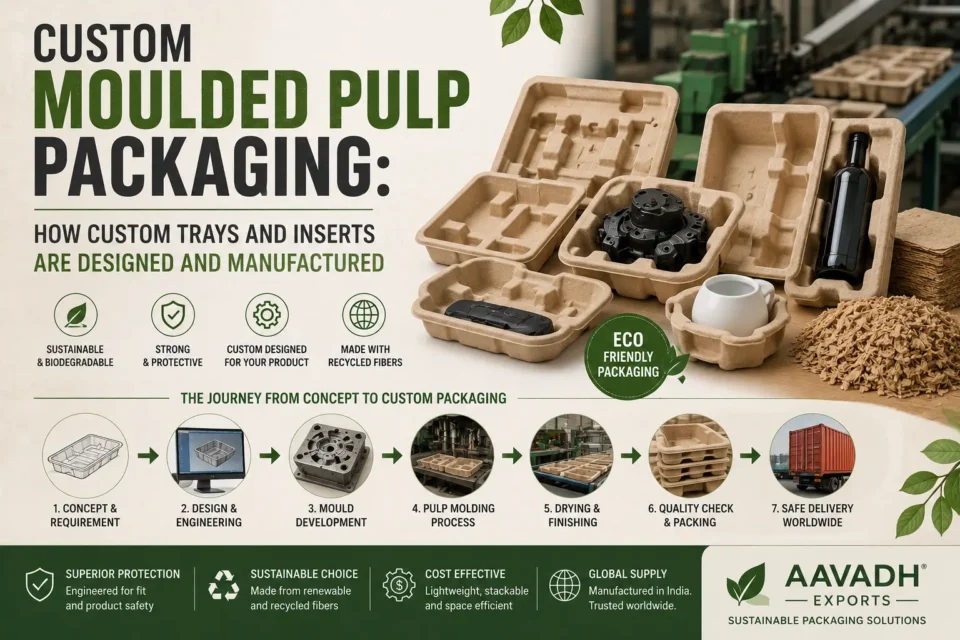

Global demand for sustainable packaging has pushed procurement teams across the US, Europe, and the Middle East to look for a dependable molded pulp packaging manufacturer in India. India has become one of the largest sourcing hubs for molded fiber products — from egg trays and fruit trays to electronics packaging inserts and industrial protective trays — thanks to abundant raw material availability (waste paper, agricultural pulp), competitive manufacturing costs, and growing compliance with international sustainability standards. But not every manufacturer delivers consistent quality at export scale, and choosing the wrong partner can mean delayed shipments, inconsistent tray strength, or rejected containers at the destination port. Here is a detailed framework for evaluating a supplier before you commit to a purchase order.
1. Raw Material Sourcing and Pulp Quality
The strength, finish, and moisture resistance of a molded pulp tray depend heavily on the pulp furnish used — recycled cardboard, waste newspaper, bagasse, or virgin kraft pulp. A serious paper pulp tray exporter will be transparent about their raw material blend and can supply lab test reports for tensile strength, compression resistance, and moisture content. If a supplier is vague about sourcing or cannot explain what fiber blend goes into their trays, treat it as a red flag. Ask specifically whether they use 100% recycled fiber, a recycled-virgin blend, or agricultural residue like bagasse, since each affects both cost and final product characteristics.
2. Manufacturing Capacity and Machinery
Ask whether the factory uses rotary pulp molding machines or reciprocating (tooling) machines. Rotary lines suit high-volume standard products like egg trays and cup carriers, offering faster cycle times and lower per-unit cost at scale. Reciprocating lines are better suited to precision industrial trays and custom molds where tighter tolerances matter. A manufacturer with both capabilities can serve a wider range of buyer requirements — from FMCG and agriculture to electronics and pharmaceutical packaging — without needing to outsource part of your order to a third party, which often introduces quality inconsistency.
3. Certifications That Matter for Export
Look for ISO 9001 (quality management systems), FSC certification (responsible fiber sourcing with chain-of-custody tracking), and where relevant, BRC or food-contact compliance for trays used with fresh produce, bakery items, or other food products. Buyers importing into the EU or US should also confirm compliance with REACH and FDA food-contact regulations if the packaging touches food directly. A manufacturer actively maintaining these certifications — not just claiming them on a sales brochure — is a strong signal of long-term reliability.
4. Customization and Tooling Capability
A good molded fiber packaging manufacturer should offer in-house mold design and tooling, so custom cavity shapes for electronics, wine bottles, cosmetics, or industrial components can be developed without long lead times or dependency on third-party toolmakers. Ask to see examples of previous custom tooling projects and typical mold development timelines, which usually run three to six weeks for a moderately complex design. Manufacturers without in-house tooling capability often add several extra weeks to any custom order, which can be a serious constraint for buyers working against product launch deadlines.
5. Export Experience and Documentation Readiness
Working with a manufacturer that already exports regularly is far smoother than one entering international trade for the first time. Check their IEC (Import Export Code), RCMC registration with the relevant Export Promotion Council, and ask for references or examples of past shipments. An experienced exporter will also proactively handle fumigation certificates for wooden pallets, phytosanitary certificates where required, and packing methods designed to survive long sea freight transit without moisture damage — a genuine risk for absorbent pulp products.
6. Minimum Order Quantity and Pricing Transparency
MOQs vary significantly depending on tray complexity. Standard designs typically carry a lower MOQ since no new tooling investment is required, while custom-tooled products usually require a higher MOQ to justify the mold development cost. A transparent supplier will share a clear cost breakdown — raw material, tooling amortization if applicable, packing, and freight — rather than offering a single opaque quote that makes it difficult to negotiate or compare against other suppliers.
7. Sample Approval Process
Never place a bulk order without physically testing samples under real-world conditions: stacking tests, humidity exposure, and drop tests for fragile goods being packaged. A confident manufacturer will offer samples quickly, typically within one to two weeks for standard designs, and will incorporate buyer feedback into a second iteration if the first sample doesn’t fully meet requirements. Suppliers who resist providing physical samples before a large order, or who charge excessively for them, are worth approaching with caution.
8. Sustainability Credentials Beyond the Product Itself
Buyers increasingly audit not just the finished product but the factory’s own sustainability practices — water recycling in the pulping process, energy sourcing for the drying stage, and waste management protocols. This is particularly relevant for brands under ESG reporting obligations in Europe and North America, where suppliers further down the chain are now routinely asked to demonstrate their own environmental practices, not just the recyclability of what they produce.
9. Communication and Responsiveness
This is an easy factor to overlook but a strong predictor of how smoothly a long-term relationship will run. During the initial inquiry and sampling phase, note how quickly and clearly a manufacturer responds to technical questions. A supplier who takes days to answer basic queries about material specifications or lead times is likely to be equally slow when a production issue or shipment delay needs urgent resolution.
10. Factory Visit or Third-Party Audit
For larger orders or long-term contracts, arranging a factory visit — either in person or through a third-party inspection agency — provides direct visibility into production conditions, quality control checkpoints, and actual machinery capacity, rather than relying solely on claims made during sales conversations. Many international buyers now build a pre-shipment inspection clause into their purchase agreements as standard practice.
Final Checklist Before Finalizing a Supplier
- Verified export history and valid IEC registration
- Clear raw material and pulp composition disclosure
- Relevant certifications: ISO 9001, FSC, and food-contact compliance where applicable
- In-house tooling and mold design capability
- Transparent MOQ, pricing, and lead time commitments
- Willingness to provide physical samples before committing to bulk production
- Responsive, clear communication during the evaluation phase
- Openness to a factory visit or third-party quality audit
Conclusion
Choosing the right bulk packaging manufacturer in India is less about finding the lowest quote and more about consistency, documentation, and long-term reliability — especially when your supply chain depends on on-time container shipments and consistent product quality across every reorder. A manufacturer who invests in certification, tooling capability, and transparent communication will save far more in avoided delays, rejected shipments, and quality disputes than a cheaper, less-established option ever could. Taking the time to evaluate a potential supplier against this full checklist, rather than price alone, is the single most effective way to build a dependable, long-term molded pulp packaging supply chain.