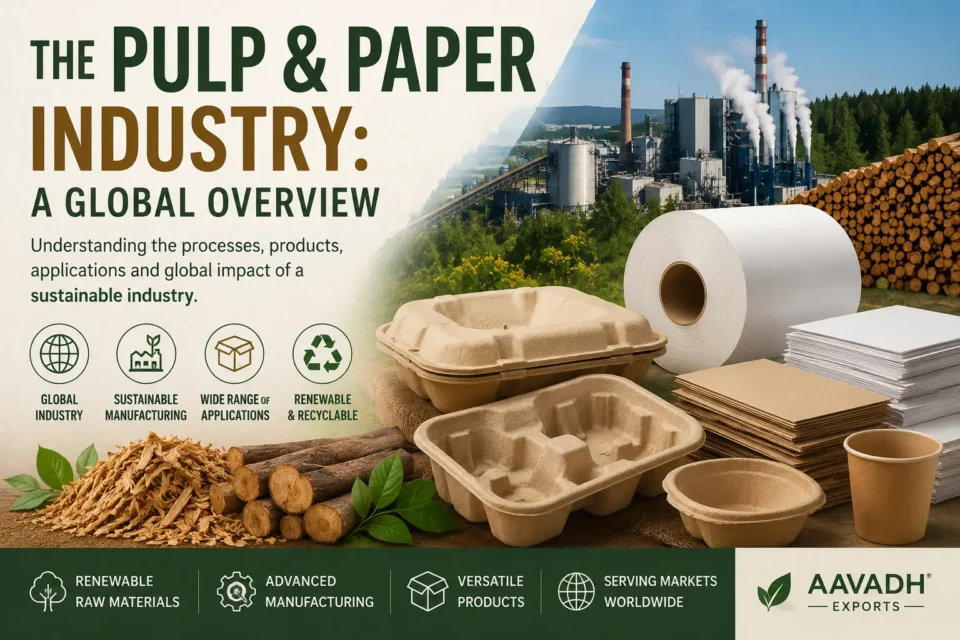
Walk into almost any warehouse, kitchen, hospital, or shipping dock in the world, and you will find something made from pulp. It might be a cardboard box, a paper cup, a medical tray, or the humble egg carton sitting in your refrigerator. Behind every one of these everyday objects sits a vast, quietly powerful global industry — one that converts wood fibre, agricultural residue, and recycled paper into materials that touch nearly every part of modern life.
The pulp and paper industry is one of the oldest continuously operating manufacturing sectors in the world, and also one of the most misunderstood. Most people think of it purely in terms of printing paper and newspapers — a shrinking market in the digital age. In reality, the industry has quietly reinvented itself. Packaging, hygiene products, industrial trays, and sustainable moulded fibre solutions now make up a growing share of global pulp demand, even as traditional print paper declines.
How Big Is the Global Pulp & Paper Industry, Really?
Globally, paper and pulp production runs into hundreds of millions of tonnes every year, spread across thousands of mills on nearly every continent. Major producing regions include North America, Northern Europe (Scandinavia in particular), China, Brazil, Indonesia, and India. Each region tends to specialise based on its natural resources — Scandinavian countries lean on softwood forests, Brazil and Indonesia on fast-growing plantation species, and India increasingly on agricultural residues and recycled fibre due to land and forest constraints.
What’s interesting is how concentrated — and yet how fragmented — this industry is at the same time. A handful of multinational pulp and paper companies account for a large share of raw pulp production, while thousands of smaller regional and specialty manufacturers convert that pulp into finished products for local and export markets. This is where much of the real innovation happens: not in the giant pulp mills, but in the specialised factories that turn raw fibre into something useful for a specific industry.
From Pulp Mills to Finished Products
It helps to think of the industry in two broad layers.
Layer one is raw pulp production — the mills that break down wood chips, bamboo, bagasse, or recycled paper into fibre slurry. This is capital-intensive, chemical-heavy, and dominated by large integrated pulp and paper manufacturers who often also run their own paper machines.
Layer two is conversion — taking that pulp (or ready-made paper) and turning it into a finished, usable product. This is where you find moulded fibre packaging manufacturers, tissue converters, corrugated box makers, and specialty tray producers. A business in this second layer doesn’t necessarily need to run its own pulping plant; it can source pulp or recycled paper stock and focus entirely on precision moulding, drying, and finishing.
This second layer is exactly where the sustainable packaging story is being written right now.
Why Packaging Is Reshaping the Pulp & Paper Industry
For decades, the loudest conversation in this industry was about print and writing paper. That conversation has shifted dramatically. Three forces are driving the change:
- Global plastic regulation. Countries across Europe, the Middle East, and Asia are tightening restrictions on single-use plastics, particularly in food packaging, electronics cushioning, and retail. Businesses that once defaulted to expanded polystyrene or plastic clamshells are actively searching for fibre-based alternatives.
- Buyer-driven sustainability demands. Retailers and international buyers increasingly require suppliers to demonstrate recyclable or biodegradable packaging as part of procurement criteria, not just as a marketing add-on.
- E-commerce and cold-chain growth. The explosion of online retail and perishable goods shipping (poultry, fruit, seafood, electronics) has created enormous demand for protective packaging that is lightweight, stackable, and shock-absorbing — a role moulded pulp fills exceptionally well.
As a result, a segment that used to be a small side note in industry reports — moulded fibre and pulp packaging — is now one of the fastest-growing categories within the broader pulp economy.
Where India Fits Into the Global Picture
India occupies an interesting position among global pulp and paper manufacturers. It doesn’t have the vast softwood forests of Scandinavia or Canada, so Indian producers have become resourceful, relying heavily on recycled fibre, bamboo, and agricultural residues like bagasse and wheat straw. This resourcefulness has, somewhat unexpectedly, made Indian manufacturers well suited to the moulded pulp packaging boom — the same recycled-fibre expertise that print paper mills built up over decades translates directly into egg trays, fruit trays, and protective packaging.
India is also home to a dense cluster of export-focused pulp and paper companies that supply international markets across the Middle East, Europe, Southeast Asia, and North America. Buyers looking for reliable pulp and paper manufacturers increasingly look to India not just for competitive pricing, but for consistent quality, compliance certifications, and the ability to handle large, recurring export orders.
What to Look for in a Modern Pulp & Paper Manufacturer
If you’re sourcing packaging or pulp-based products today, the criteria for choosing a supplier have changed. It’s no longer just about price per tonne. Buyers evaluating pulp paper manufacturers now typically weigh:
- Raw material sourcing — recycled versus virgin fibre, and whether the source is traceable.
- Production capacity and consistency — can the manufacturer support bulk, recurring export orders without quality drift?
- Certifications — ISO, FSSAI (for food-contact packaging), and other quality marks that matter for cross-border trade.
- Customisation ability — many buyers need product dimensions, wall thickness, or moulding designed around a specific product, not an off-the-shelf size.
- Communication and responsiveness — especially important for international buyers managing time zones and shipping schedules.
This last point often gets overlooked, but experienced pulp and paper companies know that a smooth order-to-dispatch process is just as important to long-term buyer relationships as the product itself.
The Road Ahead
The pulp and paper industry is not disappearing — it’s dividing. One branch continues to serve traditional print and writing needs, gradually shrinking as digital adoption grows. The other branch — packaging, hygiene, and industrial applications — is expanding rapidly, driven by sustainability regulation and shifting consumer expectations.
For manufacturers and exporters positioned in that second branch, particularly those specialising in moulded fibre and pulp-based packaging, the next decade looks less like decline and more like transformation. The raw material is the same fibre that has been used for centuries. What’s changing is what we choose to make with it — and increasingly, that means safer, lighter, more sustainable packaging for a world that is finally ready to move past plastic.
Whether you’re a first-time importer exploring sustainable packaging options or an established buyer looking to diversify your supply chain, understanding this broader industry context helps you ask better questions — and choose partners who are built for where the industry is heading, not just where it has been.
How Global Trade Patterns Are Shifting
Another under appreciated shift in this industry is where trade flows are actually happening. A decade ago, most cross-border pulp and paper trade followed a fairly predictable pattern: raw pulp exported from resource-rich countries to converting mills elsewhere, with finished paper products flowing largely within regional trade blocs. That pattern is loosening.
Buyers today are far more willing to source finished, ready-to-use packaging products directly from manufacturers in emerging exporting countries, rather than importing raw pulp and converting it domestically. This shift is being driven by a few practical realities: converting capacity is expensive to build and maintain, shipping finished lightweight moulded products has become more cost-efficient with modern logistics, and manufacturers in countries with lower production costs have invested heavily in meeting the quality and compliance standards that export buyers demand.
This is particularly visible in the moulded fibre packaging segment, where countries like India have moved from being primarily raw-material exporters to becoming genuine finished-product exporters, shipping egg trays, fruit trays, and industrial packaging directly to buyers in the Middle East, Europe, Australia, and North America. For an importer, this often means shorter, simpler supply chains — working directly with a manufacturer rather than coordinating between a pulp supplier and a separate converter.
Frequently Asked Questions
Is the pulp and paper industry shrinking or growing?
Answer: It depends entirely on which segment you look at. Traditional print and writing paper demand has been declining for years due to digitalisation. Packaging-grade pulp and paper, however — particularly moulded fibre and corrugated packaging — has been growing steadily, driven by e-commerce and plastic-reduction regulations.
Why does India export so much pulp-based packaging?
Answer: India combines abundant agricultural fibre sources (bagasse, wheat straw, bamboo), competitive manufacturing costs, and a growing base of export-experienced manufacturers who understand international quality and compliance requirements — a combination that’s hard to replicate quickly elsewhere.
What should I check before choosing an export supplier in this industry?
Answer: Look for verifiable certifications, clear communication about fibre sourcing, evidence of consistent bulk-order fulfilment, and a track record with international buyers rather than domestic-only experience.