As foam and plastic drink carriers face bans across major markets, molded pulp cup carriers have become the standard replacement for cafés, quick-service restaurants (QSR), food trucks, and delivery kitchens worldwide. This guide covers how molded pulp cup carriers compare to plastic alternatives, what specifications matter for bulk buyers, and how to evaluate a supplier for consistent, high-volume supply.
What Is a Molded Pulp Cup Carrier?
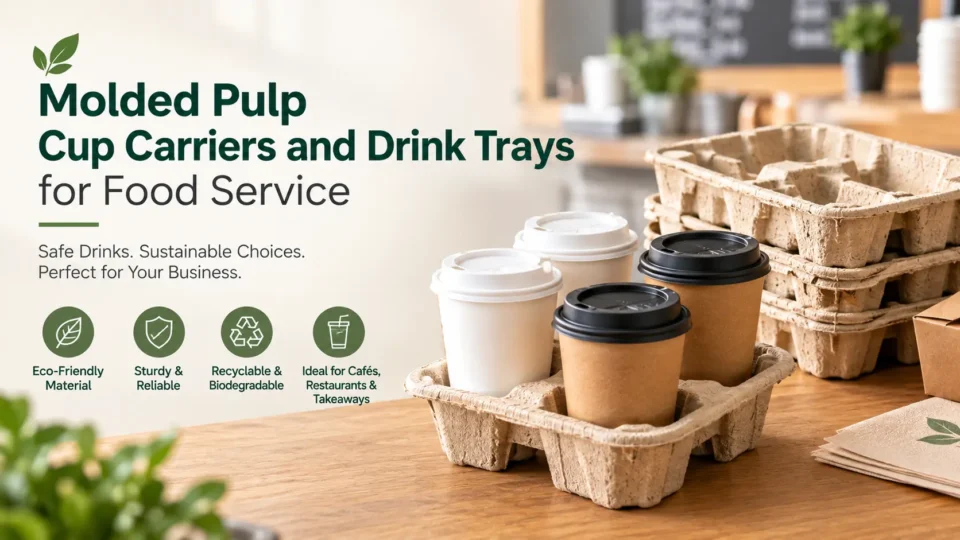
A molded pulp cup carrier is a press-formed tray made from recycled paper fiber, shaped with individual cup-holding cavities — typically in 2-cup or 4-cup configurations — designed to secure hot or cold beverage cups during transport. Many designs also include an integrated flat tray section for food items, making them a dual-purpose product for food trucks and concession stands that need to hand customers both food and drinks in a single stable unit.
The cavity design is engineered to grip the cup body just below the rim, preventing tipping without restricting easy insertion or removal by hand — a detail that matters more than it might seem, since a poorly designed cavity either lets cups wobble loose or makes them difficult to lift out one-handed, both of which lead to spills during a busy service period.
Molded Pulp vs. Plastic Cup Carriers
| Factor | Molded Pulp | Plastic (PET/PS) |
| Regulatory status | Compliant with most single-use plastic bans | Increasingly restricted (EU SUP, various US state/city bans) |
| Compostability | Yes | No |
| Grip/rigidity for 4 large cups | Strong when properly wall-thickness rated | Strong but environmentally penalized |
| Cost per unit at scale | Competitive, improving with volume | Historically cheaper, now offset by compliance/disposal costs |
| Brand perception | Positive (visible sustainability signal) | Increasingly negative in developed markets |
| Stackability for storage | High (nests flat) | Moderate |
For background on how these plastic restrictions are shaping global sourcing decisions, see our guides on the EU Single-Use Plastics Directive and broader plastic packaging regulations.
Key Specifications for Buyers
| Specification | Why It Matters |
| Cup size compatibility (e.g., 8oz–44oz) | Carrier cavity must fit both standard and large cup diameters |
| Cup count (2-cup vs. 4-cup) | Determines use case — quick café orders vs. delivery/catering batches |
| Wall rigidity | Prevents buckling under 4 large hot/cold drinks |
| Combined tray + carrier design | Useful for food trucks and concession stands needing food + drink in one unit |
| Nestability | Impacts storage footprint at the point of sale |
| Certification (compostability, food contact safety) | Needed for retail/import compliance documentation |
| Grip cutout design | Affects ease of one-handed carrying for delivery drivers |
Why Food Service Businesses Are Switching
- Ban compliance. Numerous jurisdictions across the EU, UK, and North America now restrict single-use plastic foodware items, and molded pulp cup carriers are a direct, compliant substitute that doesn’t require redesigning existing service workflows or retraining staff.
- Spill reduction and customer experience. Rigid, individually contoured cup pockets reduce the risk of drink spills during handoff and delivery — a meaningful factor for delivery-focused restaurant operations where a spilled drink means a refund, a bad review, and a repeat customer lost.
- Lower disposal cost and liability. Compostable and recyclable packaging reduces waste-stream disposal costs in jurisdictions with extended producer responsibility (EPR) fees tied to plastic packaging, an increasingly relevant cost line for high-volume QSR operators.
- Brand alignment. For cafés and QSR chains actively marketing sustainability commitments, switching from plastic to visibly natural-fiber cup carriers reinforces brand positioning at the point of customer handoff — arguably the single most visible packaging touchpoint in the entire order.
- Delivery platform requirements. Some third-party delivery and food marketplace platforms are beginning to favor or require compostable packaging from listed restaurants, making the switch a practical business requirement rather than just a values-driven choice.
Who Buys This Product
- Coffee shops and café chains
- Quick-service restaurants and delivery kitchens
- Food trucks and concession stands
- Catering and event service companies
- Foodservice distributors and wholesalers
- Stadium and venue concessions operators
Customization and Ordering Considerations
Cup carriers are typically ordered as a standard catalog item rather than heavily customized, since the cavity geometry is largely dictated by cup dimensions rather than brand preference. That said, buyers can usually request a natural or printed finish, and some suppliers offer light embossed branding on the carrier’s flat surfaces. Because this is a high-frequency consumable rather than a one-time packaging purchase, buyers should prioritize supplier questions around production capacity, consistency across repeat orders, and reliable lead times over deep customization.
Sourcing Considerations for International Buyers
Because cup carriers are a high-frequency, high-volume consumable, per-unit cost and consistent supply reliability matter more than customization for most food service buyers. When evaluating suppliers, ask about production capacity for repeat monthly orders, not just one-time bulk pricing. For guidance on the underlying manufacturing process that affects consistency and surface finish, see our explainer on how molded pulp packaging is manufactured and the difference between wet-pressed and dry-pressed molded pulp, which directly affects grip texture and print quality on branded carriers.
International buyers should also review FOB, CIF, and EXW terms to understand who bears freight and insurance responsibility for container-load orders of this lightweight, high-cube product, and our guide on calculating landed cost for building an accurate total delivered price.
Frequently Asked Questions
Can molded pulp cup carriers hold both hot and cold drinks?
Yes, molded pulp is thermally stable and commonly used for both hot coffee cups and cold/iced beverage cups without structural degradation.
Are these carriers suitable for large cup sizes like 32oz or 44oz?
Yes, but confirm cavity diameter and depth with your supplier, as carrier designs vary between standard café cup sizes and large concession/gas station cup formats.
Do molded pulp cup carriers require any special disposal instructions?
They are generally compostable in commercial composting facilities and recyclable through standard paper recycling, though local guidelines vary by municipality.
What’s a typical order volume for export/import buyers?
Because this is a high-frequency consumable, import buyers typically order in container-load or multi-container quantities rather than small trial batches, once quality is validated with an initial sample order.
Can I get a combined food tray and cup carrier in one unit?
Yes, several designs integrate a flat food-holding section alongside the cup cavities, which is popular with food trucks and concession operators who need a single handoff unit.
Get a Quote
Sourcing molded pulp cup carriers or drink trays for your food service distribution business? Contact Aavadh Exports for bulk pricing and sample requests.