Case studies are one of the most persuasive content formats for B2B packaging buyers evaluating a new supplier, because they demonstrate real execution rather than general capability claims. This walkthrough covers a representative custom molded pulp packaging project from initial brief through to ongoing reorder relationship, illustrating the process international buyers can expect when working with an experienced Indian pulp packaging manufacturer.
The Brief
A [industry — for example, consumer electronics, wine and spirits, or fresh produce] brand based in [country] needed a custom molded pulp packaging solution to replace their existing [plastic / expanded polystyrene foam] packaging. The shift was driven by [regulatory pressure on single-use plastics / internal brand sustainability targets / a desire to reduce packaging and freight costs]. The requirement included approximately [X] units per month, with a target unit cost within [X] percent of their previous packaging solution, and a firm deadline tied to their upcoming product launch or a seasonal shipping window that could not be moved.
The Challenge
Three specific challenges commonly define projects of this nature, and are worth addressing explicitly when documenting your own case study for prospective buyers.
Tooling Precision
The client’s product required tray cavities with tight tolerances to prevent movement during transit, a common challenge when replacing foam packaging, which molds tightly and precisely around a product’s exact shape, with molded fiber, which is inherently more rigid and requires more careful initial design to achieve the same protective fit without excess material use.
Lead Time Pressure
International buyers often approach a new packaging supplier only after their existing supplier has failed to deliver on time or to specification, which leaves considerably less runway than the standard tooling development timeline of four to six weeks would normally allow. Managing this compressed timeline while still delivering a properly tested, reliable design requires close coordination and realistic communication about what can and cannot be accelerated.
Compliance Requirements
Depending on the destination market, the client needed documentation proving [FSC-certified fiber sourcing / food-contact safety compliance / certified compostability under EN 13432], all of which had to be secured and verified before the very first shipment could clear customs at the destination port without delay.
The Approach
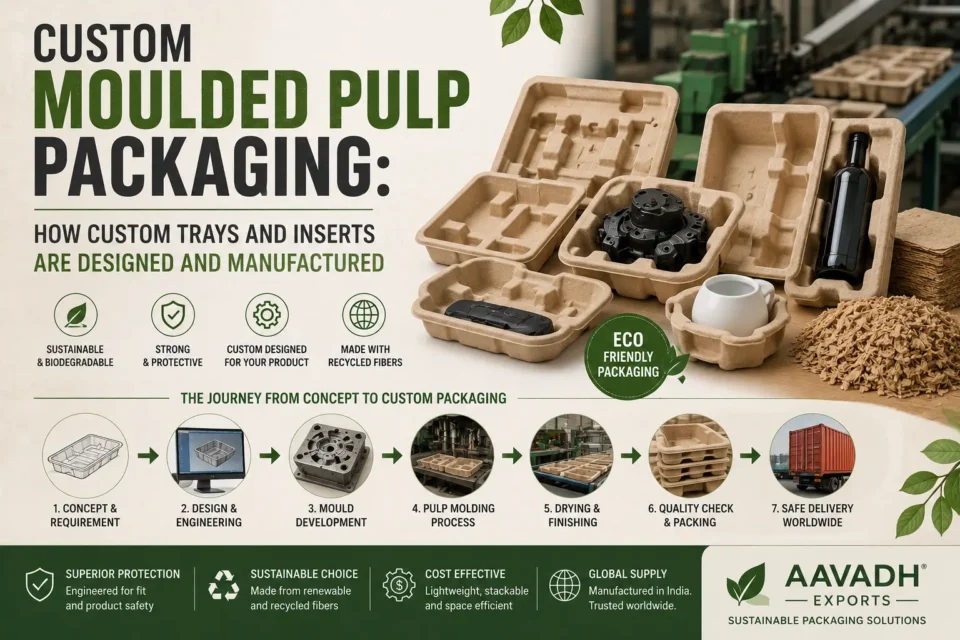
Mold design and prototyping: Three-dimensional design files were developed based on the client’s exact product dimensions and packaging requirements, followed by a rapid prototype tray produced within [X] days to allow physical fit-testing against actual product samples rather than relying solely on digital simulation.
Sample iteration: Based on client feedback gathered from drop-testing, stacking trials, and simulated transit conditions, [X] design revisions were made to improve cushioning specifically at identified stress points, ensuring the final design provided adequate protection without unnecessary material use that would increase cost and weight.
Production scale-up: Once the final design received formal client approval, production was scaled to meet the required [X]-unit monthly volume across [X] production lines, with quality control checkpoints established at each stage to catch any dimensional or strength inconsistencies before packaging left the facility.
Documentation and compliance: Required certificates, including [FSC chain-of-custody documentation, food-contact compliance testing, or compostability certification], were prepared in parallel with the production process specifically to avoid adding delay to the agreed shipment schedule once goods were ready to ship.
Logistics coordination: Finished shipments were consolidated into [X]-foot shipping containers using moisture-resistant packing methods to protect the pulp trays throughout the [X]-week sea transit period to [destination port], with particular attention paid to ventilation and humidity control given the product’s inherent sensitivity to moisture.
The Result
- On-time delivery of the first full production batch within [X] weeks of final sample approval, meeting the client’s original launch deadline without requiring any schedule extension
- A [X] percent reduction in overall packaging weight compared to the client’s previous foam-based solution, which directly reduced freight cost per unit shipped and contributed to the client’s own carbon footprint reduction goals
- Full compliance documentation delivered ahead of the shipment’s customs clearance date, avoiding any port delays or additional inspection holds that commonly affect shipments with incomplete paperwork
- An ongoing monthly reorder relationship established following the initial successful shipment, with [X] successful shipments completed to date without a single quality-related rejection
Why This Matters for Other Buyers
This project reflects a pattern common among international buyers switching to molded pulp packaging sourced from Indian manufacturers: the technical transition away from plastic or foam packaging is genuinely achievable with the right tooling partner, provided that lead times are planned realistically from the outset and compliance documentation is treated as an integrated part of the production timeline rather than an afterthought handled at the last possible moment before shipment.
Key Takeaways for Buyers Considering a Similar Switch
- Start early. Begin the tooling and sampling process at least eight to ten weeks before your required delivery date, even if a supplier quotes shorter standard lead times, to build in adequate buffer for design iteration.
- Confirm certification requirements upfront. Determine exactly which certifications your specific destination market requires before finalizing a supplier relationship, not after production has already begun, since retrofitting compliance documentation after the fact is far more difficult and time-consuming.
- Request real references. Ask potential suppliers for examples of similar past projects. A manufacturer with genuine export case studies will typically be willing to share client references, with appropriate permission, or at minimum provide detailed process examples that demonstrate real execution rather than theoretical capability.
- Plan for iteration. Expect at least one round of sample revision based on real-world testing rather than assuming the first prototype will be production-ready, and build this expectation into your project timeline from the beginning.
- Treat logistics as part of the design process. Moisture protection and container loading planning should be discussed during the design phase, not left until the shipment is ready to leave the factory.
Metrics Worth Tracking for Future Case Studies
To make future case studies as credible and data-rich as possible, it’s worth systematically tracking a few key metrics on every major project as it happens, rather than trying to reconstruct them afterward. These include: total time from initial inquiry to first shipment, number of sample iterations required before final approval, percentage improvement in packaging weight or cost versus the client’s previous solution, defect rate across the first several shipments, and client retention or reorder frequency over the following twelve months. Having this data readily available makes it far easier to produce a compelling, specific case study immediately after a project concludes, while details are still fresh and accurately recalled.
Adapting This Template for Your Own Business
This case study format can be duplicated for each major client project your business completes, with real client names (where permission has been granted), specific countries, actual unit numbers, and measured outcomes substituted into the bracketed sections above. A library of several such case studies, each covering a different industry vertical or destination market, gives prospective buyers concrete, relevant examples to reference regardless of their own specific packaging application, and significantly strengthens both search visibility and buyer confidence compared to generic capability statements alone.