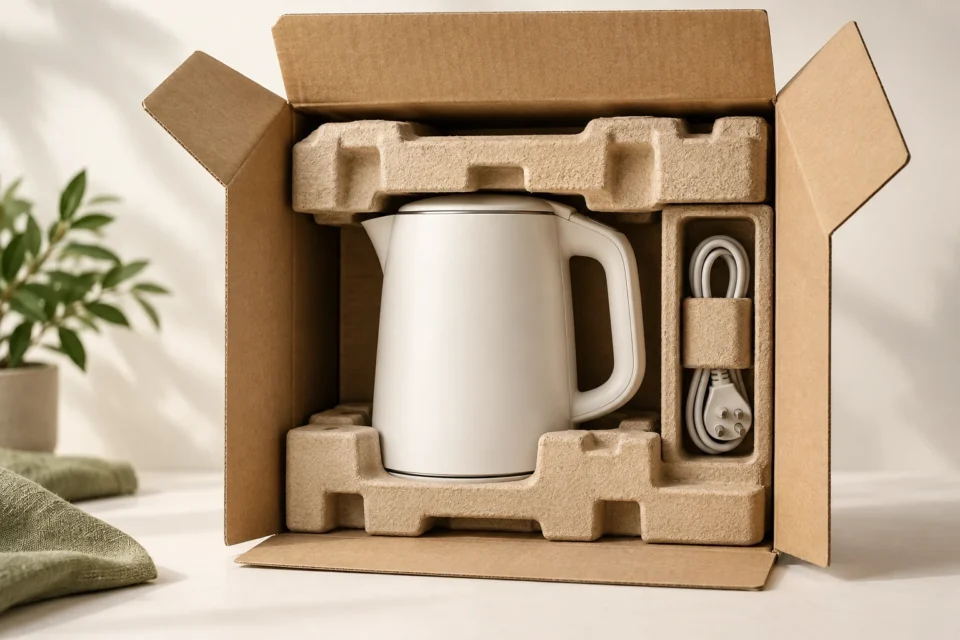
Small appliances combine weight, functional components and visible surfaces within a relatively compact product. A kettle, mixer or personal care device may include handles, controls, detachable accessories and a power cable. Custom packaging for small appliances should account for this complete assembly rather than focus only on the external body.
Molded pulp may be considered for shaped supports, end caps and accessory trays inside a suitable carton. See our electronics packaging guide for a related protective packaging application. The packaging needs to position the appliance without creating pressure on vulnerable parts. Product fit, safe handling and operation after delivery should all be included in the project brief.
Define the appliance in its shipping condition
Provide the final assembled product or a representative sample. Record maximum dimensions and weight, including any components installed during shipment. A device photographed without its handle, lid or stand may not reflect the packaging requirement that production staff will face.
List detachable parts separately. These may include a base, measuring cup, nozzle, brush or other attachment. Explain which components remain fitted and which are packed alongside the appliance. Packaging should be designed around the actual customer set so accessories do not become an afterthought.
Read Also: inserts for fragile products
Identify structural and sensitive areas
Ask the product team which surfaces can carry packaging contact and which should remain clear. Controls, displays, switches and decorative trim may be vulnerable even when the main housing is strong. A handle may be comfortable to hold but unsuitable as the main support during shipment.
Document known product weaknesses and existing damage patterns. Cracked feet, broken lids or scratched paint may point to different design issues. Clear information helps a packaging specialist consider the contact arrangement instead of simply making the insert thicker or tighter in response to an unexplained failure.
Evaluate end caps and full trays
End caps can support selected portions of an appliance, while a fuller tray may organize a product and its accessories in one layout. These are design options rather than guaranteed solutions. Product shape, weight and the outer box influence which arrangement should be assessed.
Ask how the proposed supports restrain movement in the completed carton. A lower support may locate the appliance at rest without controlling upward movement. Upper components or a revised carton arrangement may be needed. Review the complete assembly with the design team before deciding on the number of parts.
Protect projecting features
Allow deliberate space around spouts, handles, switches and other projections where contact is undesirable. These areas should be shown on drawings and highlighted in sample inspections. A feature that clears the tray during loading may still contact it when the product shifts under handling.
Also consider the closed box. Carton flaps or an upper support should not press unintentionally against a lid or control. Inspect the packed appliance from several directions before closure and compare the fit after opening. Look for witness marks or unexpected pressure that may reveal a hidden problem.
Organize cords and accessories
A power cord needs an intentional location that does not strain its entry point or allow its plug to strike the appliance. Explain how the cord is secured before packing and whether the product is supplied with a detachable adapter. A dedicated compartment may help, depending on the overall design.
Accessories should remain separated from scratch-sensitive surfaces and delicate controls. Confirm that small components cannot migrate into gaps around the main product. Include manuals and warranty documents in packing trials, since their placement can alter the fit of the upper insert or box closure.
Review surface finish and special requirements
Glossy plastics, painted metal and polished surfaces may require careful contact planning. Inspect samples for rubbing, transferred marks and visible dust after handling. Discuss any supplementary protection needed and include it in the approved specification rather than letting operators improvise on the packing line.
For electronics with electrostatic requirements, ordinary molded pulp should not be assumed to provide the required protection. Ask the product engineer to define the relevant needs and confirm material suitability with evidence. The packaging concept should accommodate the appliance’s technical requirements rather than rely on a general material description.
Match packaging to the appliance carton
Use the intended carton and closure method for evaluation. Its internal space should be compatible with the insert assembly, while its construction should suit the shipment. An insert that fits tightly in one box can behave differently in another nominally similar carton.
Keep carton specifications with the insert drawings. If purchasing changes the box to reduce cost, review the effect on fit and protection before the new carton enters production. Packaging components are related, and approving them independently can overlook interactions that only appear in the finished pack.
Include operational checks in validation
For an appliance, visual inspection after testing may not be sufficient. Agree which functions need to be checked and have the relevant product team define a safe inspection procedure. Damage to a control or internal component may not be obvious from an undamaged outer housing.
Choose transit validation with a suitable specialist based on the product and delivery route. Record the configuration and acceptance criteria beforehand. A successful test on one appliance model does not establish performance for a heavier variant or a different accessory bundle packed in the same supports.
Trial the design on the packing line
Observe loading, cord placement, accessory insertion and closure using actual staff. Check whether the design encourages a consistent orientation or creates opportunities for mistakes. Products should not require excessive force to seat correctly, and operators should not need to grip a fragile feature to position them.
Measure practical assembly time and compare the use of extra materials with the current pack. A simpler looking arrangement may still involve more handling steps. Use trial results to identify improvements and update the work instruction before approving repeat production.
Manage variants and product changes
Small appliances often share a family name while differing in controls, plugs, accessories or weight. Document which exact models are compatible with the approved packaging. Where a shared insert is proposed, assess the relevant variations instead of assuming visual similarity is enough.
Notify the packaging supplier when the appliance changes. A new stand, lid or cord arrangement can affect the cavity layout. Retain approved reference samples and drawing revisions for each configuration. This supports consistent incoming checks and reduces the chance of using outdated packaging after a product update.
Request a project-specific proposal
Prepare product drawings or samples, dimensions, weight, accessory details, carton specifications and expected quantities. Add the destination market and any previous damage issues. Aavadh Exports can assess enquiries for custom molded fiber solutions based on product size and protection requirements.
Use the contact page or email info@aavadhexports.com to discuss your appliance packaging project. Confirm feasibility, sample arrangements and commercial terms for the proposed design. Final approval should include the complete packed appliance and its intended handling conditions.