Fragile products need more than a box filled with material. They need a packaging arrangement that supports the right areas, limits unwanted movement and accounts for the conditions encountered during delivery. Custom packaging inserts for fragile products can help organize that protection, but only when the insert is designed around the actual item.
A product may break because it strikes another object, bends at a weak point or receives concentrated pressure. It may also arrive intact with scratches that make it unsaleable. Choosing the right molded pulp insert therefore begins with defining what can go wrong and what condition the customer expects on arrival.
Understand what makes the product fragile
Identify the product’s vulnerable features before selecting an insert. A glass jar may need protection around its base and closure, while a ceramic mug may have a handle that should not carry packaging loads. A decorative item may have thin projections even when its main body is relatively robust.
Record cosmetic requirements separately from breakage requirements. A polished surface might need protection from rubbing, dust or transferred marks. Explain whether small scuffs are acceptable and whether the customer will inspect the item under bright lighting. These details influence the contact surfaces and any additional wrapping needed.
Provide accurate dimensions and representative samples
Measure the full external shape, including handles, lids and protrusions. Share weight as well as dimensions because two products with similar outlines can place different demands on a tray. If the item is handmade or produced within a broad dimensional range, provide examples that represent that variation.
A drawing alone may not reveal every practical issue. Physical samples allow the designer to inspect surface finish and try possible orientations. Supply the product in its shipping condition, with its final cap, label or attachment. Packaging designed around an unfinished sample may fit differently after production changes.
Also read: custom protective packaging for glassware and ceramics
Choose contact points deliberately
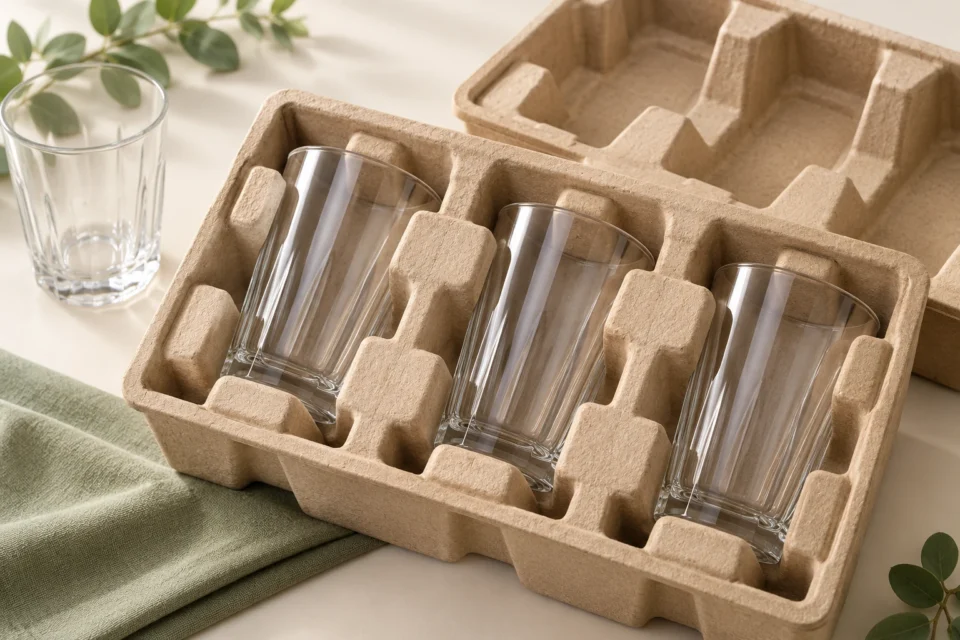
The insert should support suitable areas rather than press indiscriminately against every surface. Discuss which parts can accept contact and which need clearance. Product shape, materials and load direction determine this arrangement; there is no single cavity pattern that suits all fragile goods.
Avoid assuming the tightest possible fit is the safest. An overly tight cavity can make packing difficult and create pressure at vulnerable points. Excessive clearance can allow movement and collisions. The design goal is controlled support that can be reproduced consistently across both packaging and product variation.
Consider the whole packaging system
A molded fiber insert works with the outer carton, any upper support, closures and supplementary protection. If the carton bends or leaves too much space, a well-fitting lower tray may not prevent movement. Review the assembled box rather than judging the insert on an open tabletop.
Check how the product is restrained vertically as well as horizontally. A lower cavity may stop sideways movement while allowing the item to lift out when the box changes orientation. The design may require an upper insert, another retaining feature or a revised box arrangement, depending on the product and route.
Separate products and accessories
When several fragile items share one package, each should have an intentional position. Dividers and separate cavities can reduce contact between products, but they must remain effective when the box is handled. Confirm that lids, handles and projecting features cannot reach neighbouring items during expected movement.
Accessories deserve the same attention. A cable, metal tool or spare part can scratch the main product if it escapes its compartment. Define whether accessories need their own retention or smaller packaging. Test the complete sales set, including items that appear too minor to influence the design.
Read Also: measuring a product for custom packaging
Assess molded pulp suitability for the application
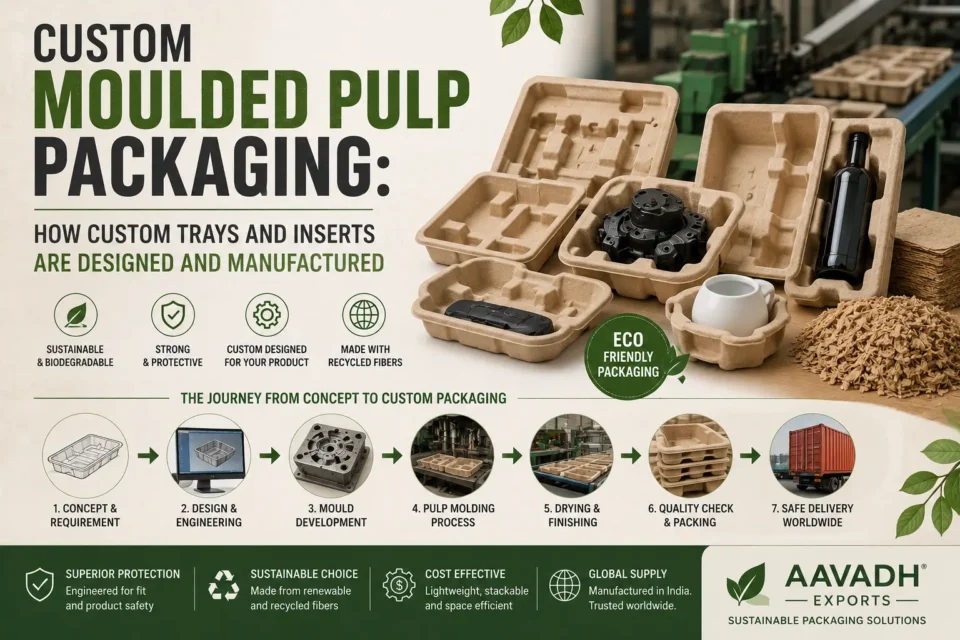
Molded pulp is a fiber-based packaging option that can be shaped into product-specific trays and supports. Its suitability depends on the design and operating conditions. Discuss surface finish, material composition and cushioning features with the supplier rather than selecting only by appearance.
Where moisture, exceptionally sensitive surfaces or special cleanliness requirements matter, describe them early. Additional measures may be needed, or another packaging approach may be more appropriate. Avoid treating “paper based” as proof that a material meets every technical requirement for a fragile item.
Run a practical packing trial
Ask the staff who will use the packaging to load representative samples. Observe whether they must force the product into place, search for its orientation or use a fragile feature as a grip. Note how long the process takes and whether the product remains correctly positioned after closure.
Also inspect removal from the customer’s perspective. Finger access can help someone lift an item without pulling on its handle or lid. A tray should communicate a clear loading and removal sequence through its geometry where possible. Good handling reduces avoidable damage before transport even begins.
Validate protection before ordering at scale
Use a testing plan suited to the intended distribution environment. A packaging laboratory can advise on the relevant procedure and test conditions. Define acceptable product condition beforehand, including breakage, leakage, surface marks and operation where applicable. Keep records of the tested product and packaging configuration.
Testing evaluates the complete packaged product, not simply the name of the material. Do not describe an insert as universally certified because another configuration passed a test. If the product, box or retaining arrangement changes, review whether the earlier evidence still applies before using it to approve a new order.
Balance cost with the consequences of failure
A low insert price may be outweighed by returns, replacement shipping and lost customer confidence. Compare packaging options using your own damage data and operational costs. Also consider packing time and the total size of the shipped box, since a protective design can affect more than the material bill.
Customization still requires a business case. For small volumes, an existing tray combined with an appropriate carton may be worth evaluating. For a difficult shape or recurring damage problem, a dedicated design may be justified. Samples and trials should guide that decision rather than a blanket preference for custom packaging.
Prepare a useful supplier enquiry
Send product measurements, weight, photos, fragile areas, current packaging details and the destination market. Explain past failures if available, including where marks or breakage occurred. Provide the complete box contents and expected order quantities. This information gives the supplier a clearer starting point for assessing a custom solution.
Aavadh Exports accepts enquiries for custom molded fiber packaging based on product dimensions and protection needs. Contact the team to discuss your fragile product and request project-specific feasibility and sample arrangements. Approve the final packed configuration before releasing a bulk order.