
Choosing between custom molded pulp packaging and standard trays is a practical sourcing decision. Custom packaging can address a specific product shape and packing arrangement, while an existing tray may offer a simpler route when its dimensions and function suit the application. Neither option is automatically the better choice.
The right answer depends on what you pack, how it travels, how many units you buy and how stable the product design is. Before paying for development or committing to an available tray, compare both options against the same requirements. This guide explains the factors that should shape that comparison.
What is a standard molded pulp tray?
A standard tray uses an existing design rather than a cavity developed exclusively for your product. Examples include established configurations for eggs, produce or beverage carrying. The supplier may have several sizes or patterns, but availability should be confirmed for the exact requirement.
The advantage is an existing starting point. You can request a sample and evaluate fit without first defining a new mold. However, “standard” does not mean stocked, immediately available or free from minimum quantities. Confirm the supplier’s commercial terms and manufacturing schedule before building a purchasing plan around it.
What makes packaging custom?
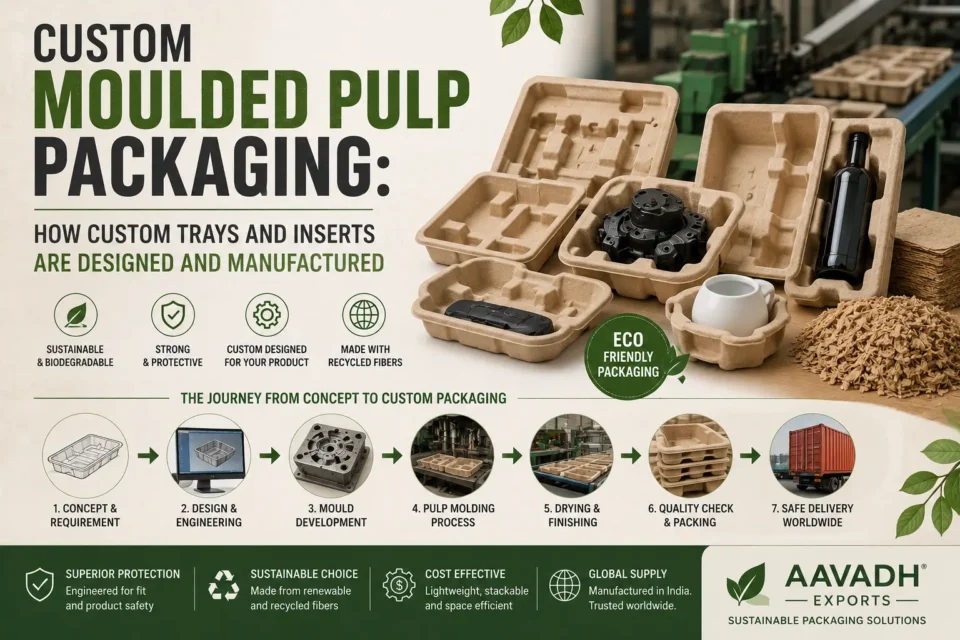
Custom molded fiber packaging is designed around a particular product, group of products or box layout. The customization may involve dimensions, cavity arrangement, retaining features or an upper and lower support system. Its purpose should be to solve an identified requirement rather than merely make the tray look different.
Development normally requires detailed product information and sample review. Read our custom mould development guide for the broader design-to-sample workflow. Ask the supplier which design and tooling stages apply to your project and which charges are included. A familiar-looking tray can still need new tooling if its critical dimensions differ from an existing design.
Start with product fit
An existing tray is worth considering when it supports the product in appropriate areas, fits the intended carton and allows acceptable handling. Measure clearance and check how the product behaves after the box is closed. The fact that it sits neatly in an open cavity is only an initial observation.
A custom design becomes more relevant when the product has an unusual shape, fragile projections or several accessories requiring separate positions. Explain the fit problem clearly. A slightly loose tray may sometimes be managed within a suitable packaging system, while a more serious mismatch may justify dedicated development.
Read Also: buyer’s checklist for custom molded pulp packaging
Compare protection at the system level
Evaluate both options inside their complete cartons with production-representative products. Compare restraint, closure, product contact and ease of removal. If one option requires extra wrapping or supports, include those components in the comparison. Otherwise, the cheaper tray may appear attractive because part of its packaging cost has been omitted.
Use an appropriate validation plan for the distribution route and product. Agree what constitutes acceptable condition before testing. An option should be approved because the packed configuration meets your requirements, not because its label says custom or because molded pulp is already used in another industry.
Assess order volume and development cost
Custom packaging may involve a development investment that needs to be considered alongside repeat production charges. For a stable product sold in recurring quantities, that investment can be evaluated across forecast usage. For a short trial or uncertain launch, a simpler existing design may be more practical.
Use realistic forecasts rather than the most optimistic sales projection. Ask for quotations at quantities you can actually order and store. If tooling ownership, maintenance or later modifications matter, clarify them in writing. These project terms can affect the long-term cost even when the initial unit prices look similar.
Account for timing and product readiness
An existing tray may shorten development because its geometry is already established, but manufacturing and delivery still take time. Custom development adds review stages that should be built into the launch schedule. Ask for a proposed sequence, including when samples can be evaluated and when production can begin.
Avoid commissioning final tooling around a product that is still changing. A revised cap, accessory or overall dimension can affect the insert. If the product is not final, explain that status and discuss a provisional development approach. The cost of repeated changes should form part of the sourcing decision.
Consider packing efficiency
Compare how staff use each option during a small packing trial. A standard tray that needs several manual adjustments may take longer than expected. A custom insert that is difficult to orient can also create delays. Practical use matters more than the number of cavities shown in a drawing.
Record loading time, additional materials and assembly errors. Check whether inserts separate easily from stacks and whether products can be loaded consistently. If staff use a top support or foldable component, include those steps. Small differences become commercially relevant only when measured against your real packing volume.
Read Also: Packaging price and tooling guide
Review storage and shipping volume
The insert’s nesting behavior, quantity per bundle and fit within master cartons affect storage planning. Request packed dimensions for the supplied packaging, not just dimensions of one loose tray. Two designs of similar footprint may occupy different amounts of space when nested.
Then review the finished product shipment. A custom insert may allow a different box arrangement, but reduced freight cost is not guaranteed. Compare actual carton dimensions, packing quantities and your carrier or freight quotation. Separate the shipment of empty packaging from the later shipment of your packed products.
Think about product families and future variants
If several SKUs share the same body shape, discuss whether one insert can serve them safely. A common design may simplify inventory, but it must accommodate the relevant variation without compromising restraint. Where necessary, evaluate interchangeable components or distinct cavities rather than forcing every model into one layout.
Also consider how easy the design will be to update. A dedicated cavity can become unsuitable after a product redesign. An existing tray might offer more flexibility, although flexibility should never be mistaken for verified protection. Make product change notifications part of your packaging purchasing process.
A practical decision method
List the essential requirements first: fit, protection, handling, appearance, quantity and delivery. Request available standard samples and discuss custom feasibility against that same list. Compare complete costs only after identifying the components each option needs. This produces a more useful decision than comparing two quoted tray prices in isolation.
Choose the standard option when it demonstrably meets the requirement and offers the better commercial arrangement. Choose a custom design when its functional benefits justify development and can be validated. If neither meets the requirement, revisit the carton, product orientation or packaging material instead of approving a weak compromise.
Discuss your application with Aavadh Exports
Aavadh Exports welcomes enquiries for standard product categories and custom molded fiber solutions. Share dimensions, weight, photos, box details and expected quantities through the contact page. Ask which existing designs can be evaluated before deciding whether a dedicated packaging project is needed.