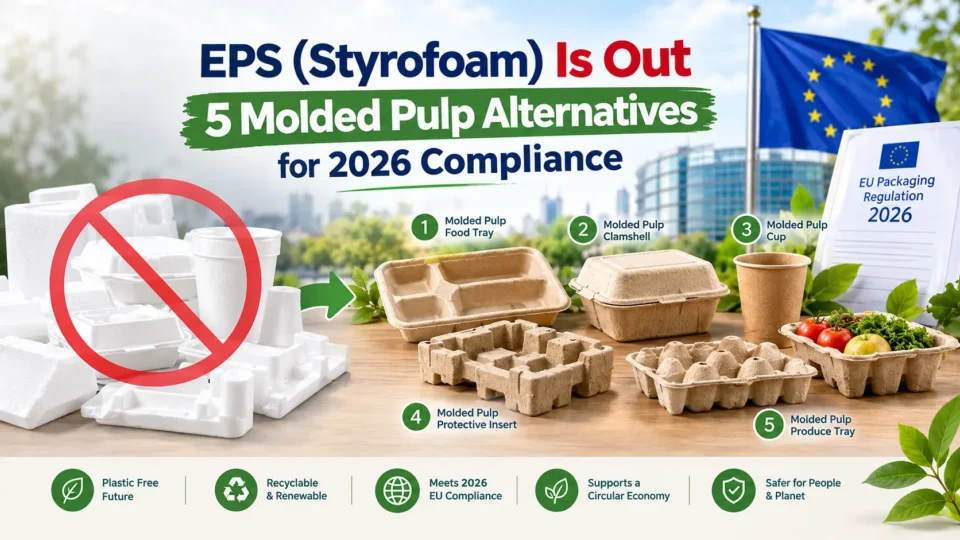
Expanded polystyrene has had a good run. It’s cheap to mold, light to ship, and cushions almost anything you put in a box. It’s also on its way out — and if you’re still specifying it for food containers, protective inserts, or cushioning packaging in 2026, you’re carrying regulatory risk that’s no longer worth the savings.
EPS food and beverage containers and cups have actually been banned in the EU since 2021 under the Single-Use Plastics Directive, and enforcement has only tightened since. The UK’s approach to packaging is heading the same direction through the Plastic Packaging Tax and a broader Extended Producer Responsibility push. Add rising freight costs tied to EPS’s poor recyclability (most municipal systems simply don’t take it) and the reputational risk of shipping foam in an era when buyers actively screen suppliers for sustainable packaging import EU credentials, and the case for switching stops being about compliance alone.
The good news: you don’t have to give up cushioning performance to get there. Molded pulp — pressed, dried cellulose fiber — has matured into a genuine styrofoam packaging alternative across nearly every use case EPS used to own. Here’s why EPS is being phased out, five molded pulp alternatives worth knowing by use-case, and how they actually compare on cost and performance.
Why EPS Is Being Pushed Out
Three forces are converging on EPS at the same time, which is why 2026 feels like the year the shift became unavoidable rather than optional.
Regulatory pressure. EPS food containers and cups are banned outright in the EU. The UK doesn’t ban EPS directly, but virgin plastic packaging — which is what most EPS is — gets hit by the Plastic Packaging Tax at £228.82 per tonne from April 2026, and that cost only climbs.
Recyclability. EPS is technically recyclable, but the economics rarely work. It’s bulky, low-density, and expensive to transport to the handful of facilities that process it. In practice, the vast majority of EPS packaging ends up in landfill or as litter, which is exactly the outcome regulators are targeting.
Buyer pressure. Retailers, marketplaces, and B2B buyers increasingly screen suppliers on packaging material as part of procurement, independent of what regulation strictly requires. Foam packaging is becoming a red flag in RFQs even where it’s technically still legal.
Molded pulp addresses all three at once: it’s outside the scope of plastic-specific regulation, it’s genuinely recyclable and often compostable, and it reads as a credible sustainability commitment rather than a marketing claim.
5 Molded Pulp Alternatives by Use-Case
1. Molded Fiber Corner and Edge Protectors — replacing EPS corner blocks
For furniture, appliances, and large equipment, EPS corner blocks have long been the default. Molded pulp corner and edge protectors deliver comparable impact absorption for drop and edge-load scenarios, and they’re easier to source in custom dimensions without the tooling lead times EPS block-molding often requires.
2. Custom Molded Fiber Trays — replacing EPS electronics inserts
This is where the switch matters most for anyone shipping electronics packaging. EPS inserts have traditionally cradled circuit boards, small appliances, and delicate components during transit. Custom molded fiber trays, engineered to the exact product geometry, hold components just as securely, with far better stacking density in the warehouse and none of the static-related handling concerns that come with foam in electronics environments.
3. Pulp Cushioning Pads — replacing loose-fill EPS peanuts and foam sheets
Loose-fill foam peanuts are probably the most visible EPS product to consumers, and also one of the easiest to replace. Molded and shredded pulp cushioning pads provide equivalent void-fill and shock absorption for general shipping, without the static cling and the “what do I even do with this” problem that foam peanuts create for the end customer.
4. Molded Pulp Food Trays and Containers — replacing EPS food packaging
This is the category under the most direct regulatory pressure, since EPS food containers and cups are explicitly banned in the EU and heavily disincentivized in the UK. Molded pulp food trays — for produce, bakery, meat, and prepared meals — hold shape, resist moisture with the right coating, and are compostable in most cases, making them a straightforward swap for foodservice and retail packaging lines.
5. Heavy-Duty Molded Fiber Pallet and Base Trays — replacing structural EPS packaging
For industrial and appliance packaging where EPS has historically provided a rigid base or pallet-level structure, heavy-duty molded fiber trays and base units now offer comparable load-bearing performance for palletized shipping, with the added benefit of being far easier to flatten, bale, and recycle at the destination warehouse.
Cost and Performance Comparison
Unit-for-unit, EPS is often still marginally cheaper to produce, which is exactly why so many suppliers haven’t switched yet. But unit cost isn’t the full picture once you account for the total landed and lifecycle cost:
| Factor | EPS Foam | Molded Pulp |
|---|---|---|
| Unit production cost | Lower | Slightly higher |
| UK Plastic Packaging Tax exposure | Yes (virgin plastic) | None (out of scope) |
| EU market access (food packaging) | Banned | Compliant |
| End-of-life handling | Landfill in most regions | Recyclable / compostable |
| Shipping density | Bulky, low density | Nests and stacks efficiently |
| Buyer perception in RFQs | Increasingly flagged | Preferred |
| Static/electronics handling | Requires anti-static treatment | Naturally non-static |
Once you fold in tax exposure, market access, and freight density, molded pulp frequently comes out ahead on total cost — not just compliance — especially for anyone shipping into the UK or EU where the regulatory cost of EPS is compounding every year.
Migration Checklist
If you’re planning to move off EPS this year, here’s a sensible sequence rather than a full-catalogue overhaul overnight:
- Start with your highest-regulatory-risk SKUs — anything EPS touching food, or anything shipping into the EU, first.
- Request samples matched to your exact product geometry rather than a generic tray — cushioning performance depends heavily on custom fit.
- Run a drop-test comparison against your current EPS spec before committing to full production volumes.
- Check moisture and barrier requirements for food-contact items — molded pulp can be coated for grease and moisture resistance without compromising compostability, but this needs to be specified upfront.
- Recalculate landed cost including tax exposure, not just unit price, so the comparison reflects the real total.
Where Aavadh Exports Fits In
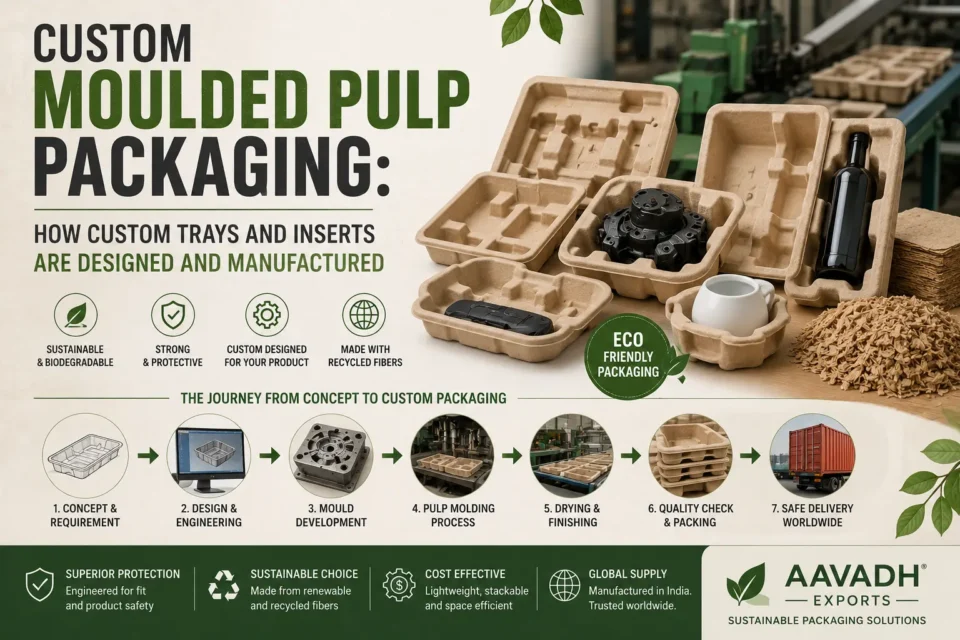
We manufacture custom molded fiber packaging and electronics packaging trays built to replace EPS across all five categories above — corner protectors, custom trays, cushioning pads, food containers, and heavy-duty structural trays — engineered to your exact product dimensions rather than sold as generic stock shapes.
Ready to see how it performs against your current EPS packaging? Request a sample of custom molded fiber packaging built to your product spec, and run your own side-by-side comparison before you commit to a full production order.
A Few Honest Trade-Offs Worth Knowing
No material switch is entirely without trade-offs, and it’s worth being upfront about them rather than pretending molded pulp is a perfect drop-in for every EPS application.
Lead time on custom tooling. Generic EPS blocks can sometimes be sourced off-the-shelf faster than a custom molded fiber tray engineered to your exact product geometry. If you need a one-off, low-volume run with no lead time, this is worth planning around. For recurring production orders, tooling cost amortizes quickly and stops being a factor.
Moisture sensitivity without proper coating. Uncoated molded pulp isn’t naturally as water-resistant as closed-cell EPS foam. For applications with genuine moisture exposure — outdoor storage, refrigerated transport, high-humidity shipping lanes — you’ll want a moisture-resistant coating specified upfront, which is a standard option but does need to be requested rather than assumed.
Weight, in some cases. Molded pulp is generally denser than EPS foam of equivalent volume, which can add a small amount of shipping weight for very lightweight, high-volume cushioning applications. In practice this is rarely decisive once you weigh it against EPS’s poor stacking density and regulatory cost, but it’s worth including in your own freight calculations rather than assuming it’s a wash.
None of these are reasons to stay on EPS — they’re just the details that separate a rushed material swap from one that actually holds up in production. A quick conversation about your specific use case upfront usually resolves all three before they become a problem.