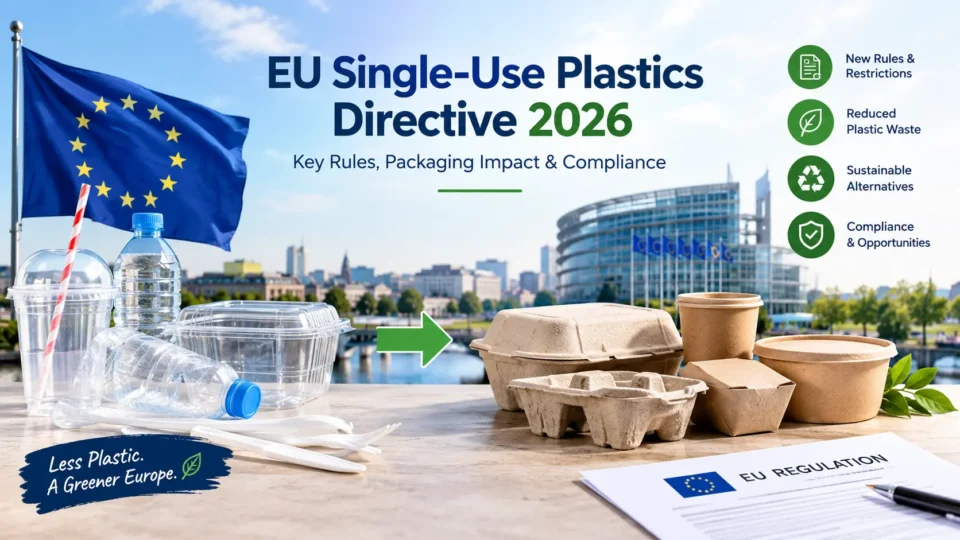
There’s a bit of confusion floating around the phrase “EU SUP Directive 2026,” and it’s worth clearing up before we get into the practical part. The headline bans under the EU Single-Use Plastics Directive — plastic cutlery, plates, straws, stirrers, cotton bud sticks, and expanded polystyrene (EPS) food containers and cups — have actually been law since July 2021. If you’re still supplying any of those into the EU market, you’re not looking at a future compliance deadline; you’re already out of compliance today.
What 2026 actually brings is different, and in some ways it matters more for packaging importers than the original ban did: this is the year each EU member state has to show a measurable, quantified reduction in single-use plastic consumption, measured against a 2022 baseline. On top of that, from August 2026, food-contact packaging across the EU has to be fully PFAS-free, alongside recyclability-by-design requirements rolling out under the wider Packaging and Packaging Waste Regulation. So “2026” isn’t one deadline — it’s a tightening of the whole framework, and it’s the year enforcement stops being theoretical.
For anyone importing packaging into EU markets, here’s what’s actually changing, what’s banned versus restricted, where molded pulp fits into the compliance picture, and what to do next.
What the 2026 Changes Actually Mean
Directive (EU) 2019/904 set up a layered system rather than a blanket ban. Some items were outlawed outright because viable non-plastic alternatives already existed. Others were left in the market but subjected to consumption-reduction targets, labelling rules, and Extended Producer Responsibility (EPR) schemes.
2026 is the checkpoint year for that second category. Member states now have to demonstrate real, quantified drops in consumption of items like plastic drinking cups and food containers for immediate consumption — not just report that awareness campaigns happened. That means national governments are under pressure to tighten enforcement, and that pressure flows downstream to importers and retailers through stricter EPR fee structures and closer customs scrutiny of packaging composition at the point of entry.
Layer on the PFAS-free requirement landing in August 2026 for food-contact materials, and you’ve got a genuine compliance impact even for products that were never touched by the original 2021 ban. A paper-lined container that happens to use a PFAS-based grease barrier, for example, now needs reformulating regardless of whether it was ever classified as “plastic packaging” in the first place.
Banned Items vs. Restricted Items — The Distinction That Matters
It’s worth being precise here, because getting this wrong is an expensive mistake for an importer.
Banned outright, since 2021, still enforced now:
- Single-use plastic cutlery (forks, knives, spoons, chopsticks)
- Single-use plastic plates
- Plastic straws and stirrers
- Cotton bud sticks with plastic stems
- Expanded polystyrene (EPS) food and beverage containers and cups
- All oxo-degradable plastic products
Restricted, not banned, but under consumption-reduction pressure:
- Plastic drinking cups (including lids)
- Plastic containers for food intended for immediate consumption
New requirement layer, effective 2026:
- PFAS-free food-contact packaging (from August 2026)
- Design-for-recyclability standards under the broader Packaging and Packaging Waste Regulation
If you’re supplying EU markets and your current line-up includes any EPS trays, EPS protective packaging, or EPS food containers, you’re not looking at a future compliance project — you’re already exposed under existing law, and the 2026 enforcement tightening makes that exposure more visible, not less.
Where Molded Pulp Fits
This is the part that makes molded pulp a genuinely strategic material choice rather than just an eco-marketing checkbox.
Molded fiber and molded pulp packaging — made from bagasse, recycled paper, or virgin wood pulp — was never inside the SUP Directive’s ban list to begin with, because it’s not a single-use plastic product. It’s already the compliant alternative that the Directive’s own guidance points toward for categories like food containers, trays, and cushioning. When the EU lists what should replace banned EPS containers and plastic cutlery, molded fiber, paper, and bagasse are explicitly named as the direction of travel.
That gives molded pulp two separate advantages for EU-bound importers right now:
Zero exposure to the existing bans. No reformulation, no risk of customs rejection at the border for restricted materials.
Positioned ahead of the 2026 PFAS-free requirement, provided the coating or barrier treatment (if any) is genuinely PFAS-free — which is standard for uncoated or water-based-barrier molded pulp products, but worth confirming with your supplier in writing.
For protective packaging specifically — electronics cushioning, industrial component trays, produce and egg packaging — molded pulp replaces EPS foam functionally as well as materially. Same cushioning role, same stackability, without carrying any of the EPS compliance risk.
Next Steps for EU Buyers
If you’re importing into the EU right now, here’s a practical sequence to work through:
- Audit your current SKU list against the banned-items list first. Any EPS component anywhere in your packaging (not just primary packaging — think void-fill and protective inserts too) needs to move immediately, not on a future timeline.
- Check restricted-category exposure. If you’re supplying plastic cups or food containers for immediate consumption, get ahead of the consumption-reduction pressure now rather than waiting for your specific member state to tighten EPR fees.
- Get PFAS documentation from every supplier before August 2026. This applies even to packaging that was never plastic — coatings and barrier layers are where PFAS hides.
- Request material declarations for anything sold as “compostable” or “biodegradable.” These claims don’t automatically mean SUP-compliant, and some biodegradable plastics still fall under restricted or banned categories.
- Model the switch to molded pulp for at-risk SKUs. For trays, containers, and protective packaging, it’s usually a like-for-like functional swap rather than a redesign.
How Aavadh Exports Can Help
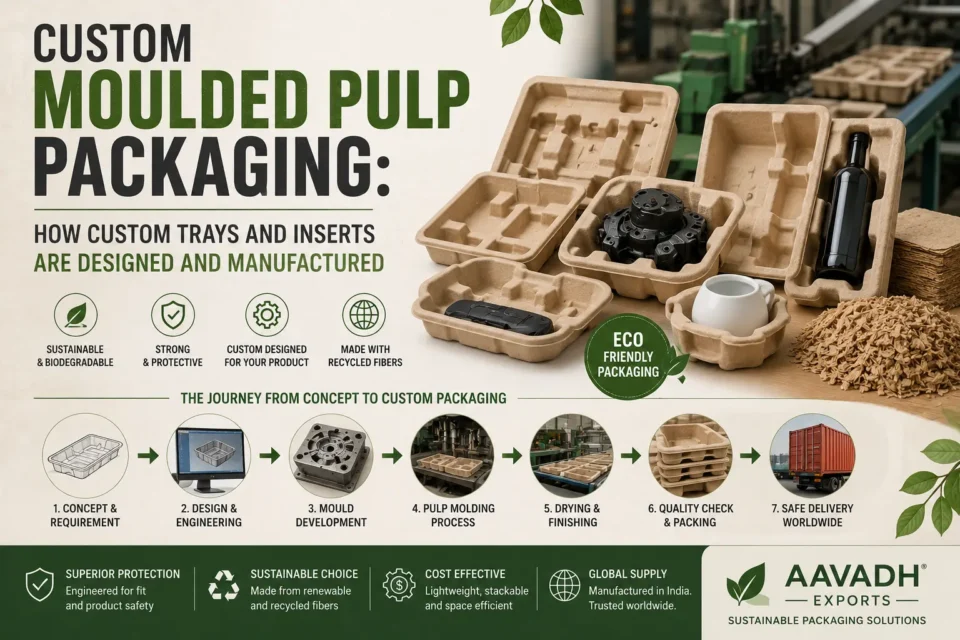
We manufacture molded pulp packaging built specifically for exporters navigating EU compliance — trays, protective inserts, and custom molded fiber components made from bagasse and recycled pulp, with material declarations ready to hand to your EU customs broker or compliance team.
If you’re not sure whether a specific SKU in your current lineup is exposed under the SUP Directive or the incoming PFAS rules, it’s worth a quick conversation before your next shipment goes out rather than after customs flags it.
Not sure where you stand? Message us on WhatsApp for a quick compliance consult — send us your current packaging spec and we’ll tell you plainly whether it’s exposed, and what a molded pulp equivalent would look like.
Frequently Asked Questions From EU-Bound Importers
Is molded pulp automatically compliant with the SUP Directive?
Yes, in the sense that it was never classified as a single-use plastic product to begin with, so the ban list simply doesn’t apply to it. That said, “compliant” doesn’t mean “no documentation needed” — you should still get a material declaration from your supplier confirming fiber composition, since customs and EPR auditors may ask for it, especially as scrutiny increases through 2026.
Does the SUP Directive apply to protective packaging, or only food packaging?
The core bans (cutlery, plates, straws, EPS containers) are food-service and food-packaging focused. But the broader shift toward the Packaging and Packaging Waste Regulation — running alongside the SUP Directive — does reach into protective and transport packaging more generally, particularly around recyclability-by-design requirements. If you’re shipping electronics packaging or industrial protective inserts using plastic foam, it’s worth reviewing that separately even if it’s not touched by the original SUP ban list.
What happens if I keep shipping EPS food containers into the EU anyway?
You risk shipment rejection or seizure at the point of entry, since these are outright banned rather than merely discouraged. Beyond the immediate shipment risk, EU distributors and retailers are increasingly refusing to stock banned materials regardless of enforcement gaps at any individual border, since it exposes them to liability too.
Is there a grace period for the PFAS-free requirement?
Based on current guidance, the August 2026 timeline for PFAS-free food-contact packaging is being treated as a hard requirement rather than a phased-in target, so it’s worth getting supplier confirmation well ahead of that date rather than close to it.
If any of this touches a product line you’re currently sourcing, it’s worth getting a straight answer before your next production run rather than after a shipment gets flagged.