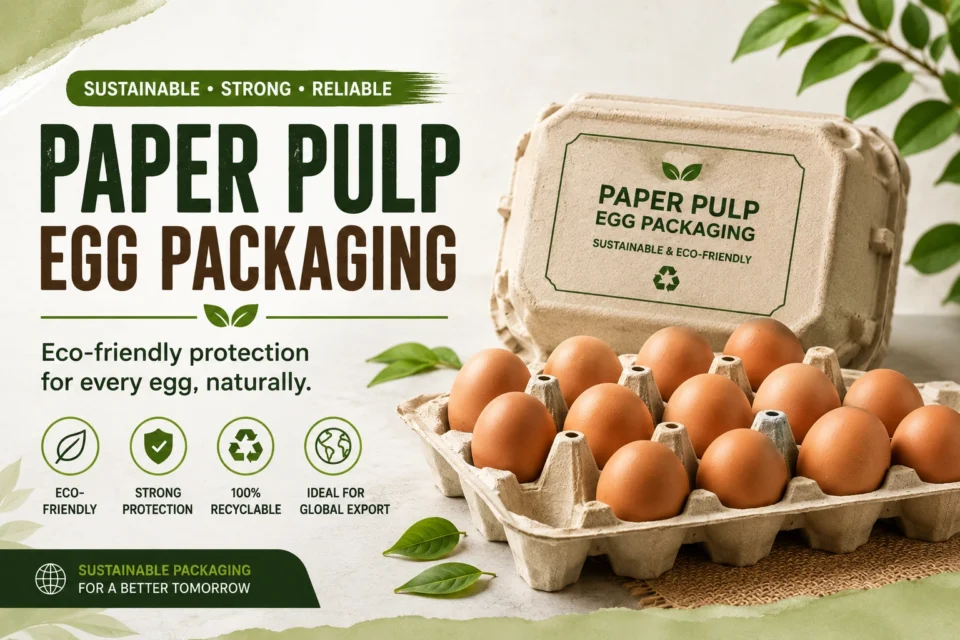
For poultry farms, egg distributors, and food businesses, packaging isn’t just about presentation — it’s directly tied to product safety, spoilage rates, operational cost, and increasingly, sustainability compliance. Paper pulp egg packaging has become the standard choice across most of the global poultry industry, and for good reason. Here’s a detailed look at why it works so well for this specific business need.
Why Paper Pulp Is the Standard for Egg Packaging
Eggs are fragile, irregularly shaped, and need individual separation to avoid breakage during handling and transport. Paper pulp egg trays are specifically molded with cavities designed to cradle each egg securely, preventing contact between eggs and absorbing shock during movement — something flat or generic packaging simply can’t provide.
This isn’t a new innovation; molded pulp egg trays have been the industry standard for decades. What’s changed more recently is the added pressure — and opportunity — around sustainability, cost efficiency, and export compliance, which has made choosing the right pulp packaging supplier a more strategic decision for poultry and food businesses.
Key Benefits for Poultry and Food Businesses
1. Reduced Breakage and Product Loss
The primary functional benefit of molded pulp egg trays is breakage prevention. Individual cavities keep eggs separated and cushioned, significantly reducing the product loss that comes from eggs shifting or knocking against each other during transport — a direct impact on a poultry business’s bottom line.
2. Breathability for Freshness
Unlike sealed plastic packaging, paper pulp trays allow natural airflow around the eggs. This breathability helps regulate moisture and temperature, supporting freshness during storage and transit — particularly relevant for businesses shipping over longer distances or export routes.
3. Cost-Effectiveness at Volume
For businesses purchasing in bulk, paper pulp trays are typically more cost-effective than plastic alternatives, especially when sourced from manufacturers using recycled paper as the primary raw material. At scale, this cost difference compounds meaningfully across large or recurring orders.
4. Sustainability and Regulatory Alignment
As plastic packaging regulations tighten across major markets — the EU’s Packaging and Packaging Waste Regulation, the UK’s Plastic Packaging Tax, and various US state-level Extended Producer Responsibility laws — biodegradable pulp packaging helps poultry and food businesses stay ahead of compliance requirements rather than scrambling to adapt later.
5. Stacking and Storage Efficiency
Molded pulp egg trays are designed to nest and stack efficiently, reducing storage space requirements in warehouses and during transport — an operational advantage that becomes more significant as order volumes grow.
6. Export-Ready Durability
For poultry and food businesses selling into international markets, packaging needs to withstand longer transit times and multiple handling points. Well-manufactured pulp egg trays are built with this in mind, offering the structural consistency needed for export-grade reliability.
Choosing the Right Egg Tray Size and Configuration
Not all egg trays are the same — cavity count, size, and depth vary based on regional standards and specific business needs. Common configurations include 30-cell trays (a global standard for many markets), as well as smaller or larger custom configurations depending on packaging and shipping requirements. Getting this right matters, since a poorly matched tray size can lead to instability during transport or inefficient use of packing space. For a full breakdown of sizing options, see our guide on egg tray sizes and cell configurations.
What to Look for in an Egg Packaging Supplier
For poultry and food businesses, choosing a supplier isn’t just about price per unit. A few factors matter significantly more at scale:
- Consistency across bulk orders — uniform tray strength and dimensions, since even small variations can affect stacking and shipping efficiency
- Production capacity — the ability to reliably fulfill recurring, high-volume orders without delays
- Food safety alignment — appropriate certifications and hygienic manufacturing practices
- Export documentation experience — particularly important if you’re sourcing internationally, where customs and shipping documentation can otherwise slow down orders
From Local Supply to Export Markets
Many poultry and food businesses start by sourcing egg packaging locally, but as operations scale or shift toward export markets, sourcing directly from established manufacturers — particularly those experienced in international shipping — often becomes more cost-effective and reliable. If you’re exploring sourcing options from overseas manufacturers, our guide on how to import molded pulp packaging from India walks through the process.
At Aavadh Exports, we manufacture and export paper pulp egg trays specifically built for poultry and food business needs — from standard configurations to custom sizing, with export-grade consistency and documentation support for international buyers. Learn more about our manufacturing process or explore our full product range.
Frequently Asked Questions
What size egg tray do most poultry businesses use?
The 30-cell configuration is one of the most widely used global standards, though many businesses use custom sizes based on regional packaging norms and shipping requirements.
Are paper pulp egg trays food-safe?
Yes, when manufactured under proper hygiene and quality standards, paper pulp egg trays are widely used and accepted for direct egg packaging across the poultry industry.
How much can pulp egg trays reduce breakage compared to other packaging?
While exact figures vary by handling conditions, properly designed molded pulp trays significantly reduce breakage compared to loose or improperly cushioned packaging, since each egg is individually cradled and separated.
Can egg tray sizes be customized for specific packing requirements?
Yes, manufacturers can produce custom cavity counts, sizes, and depths based on a poultry or food business’s specific packing and shipping needs.
Is it cheaper to import egg trays in bulk than source locally?
This depends on order volume, shipping costs, and local pricing, but many businesses find that direct bulk sourcing from established export manufacturers offers better cost efficiency at scale, particularly for recurring large orders.