When most people picture moulded pulp packaging, they think of egg trays. But electronics packaging is now the largest single end-use category for moulded fibre globally — bigger than food packaging, bigger than industrial protective packaging. Smartphone manufacturers, home appliance brands, and consumer electronics companies have been quietly replacing expanded polystyrene (EPS) foam inserts with moulded pulp for years, and the trend has accelerated as sustainability requirements tighten across major export markets.
If your business manufactures, imports, or distributes electronics — from small accessories to full-sized appliances — this shift is worth understanding, because it affects both your packaging costs and how your product looks on a shelf or a doorstep.
Why Electronics Brands Are Moving Away From Foam
EPS foam has been the default electronics packaging material for decades for a simple reason: it’s lightweight, cheap to produce, and moulds easily into precise cavities that cradle delicate components. But several pressures are pushing brands away from it:
- Regulatory pressure. Foam is one of the hardest plastics to recycle in practice — most municipal recycling systems don’t accept it, and it’s explicitly targeted by an increasing number of plastic-reduction regulations globally, including several Australian state bans and EU packaging rules taking effect through 2026.
- Brand perception. Foam has become a visible symbol of “bad” packaging for environmentally conscious consumers. Unboxing videos and social media have made packaging material a genuine part of brand reputation, not just a logistics decision.
- Retailer requirements. Major retailers increasingly push suppliers toward recyclable or compostable packaging as part of their own sustainability commitments, and foam packaging can be a sticking point in retail onboarding.
- Shipping and storage inefficiency. Foam is bulky relative to its protective value, taking up warehouse and container space that moulded pulp — which can often be nested and compressed more efficiently before final forming — uses more economically.
None of this means foam disappears overnight — it still has genuine performance advantages in some applications. But for a growing share of electronics packaging, moulded pulp now performs well enough that the sustainability and brand upside tips the decision.
How Moulded Pulp Protects Delicate Components
The core question for any electronics brand considering a switch is simple: will it protect the product as well as foam does? For most applications, the answer is yes, provided the tray or insert is engineered correctly.
Moulded pulp’s fibrous structure absorbs shock and vibration effectively — similar cushioning behavior to what makes it the standard for protecting eggs, which are about as fragile as a household product gets. For electronics specifically, this translates into:
- Impact absorption during drops and rough handling — the fibre structure compresses slightly on impact rather than transmitting force directly to the product, similar in principle to how corrugated cardboard works, but with more consistent thickness control
- Vibration dampening during transit — important for components with small moving parts or sensitive internals, where sustained vibration over a long shipping journey can cause more damage than a single impact
- Secure cavity fit — a well-designed custom mould holds the product firmly in place, preventing it from shifting inside the box, which is often the actual cause of transit damage rather than a single hard impact
- Moisture and static considerations — moulded pulp is naturally free of the static charge that can affect some plastics, though for highly static-sensitive components, manufacturers often combine pulp trays with a thin anti-static liner rather than relying on the pulp alone
The key variable isn’t really “pulp vs foam” in the abstract — it’s whether the specific mould is designed correctly for your product’s weight, fragility, and shipping conditions. This is where custom mould design becomes important.
Custom-Moulded Inserts vs Standard Trays
Electronics packaging almost always benefits from custom tooling rather than standard tray shapes, because component geometry varies so much between products.
Standard trays work for simpler, more uniform items — cables, small accessories, or components that don’t need a precisely contoured cavity.
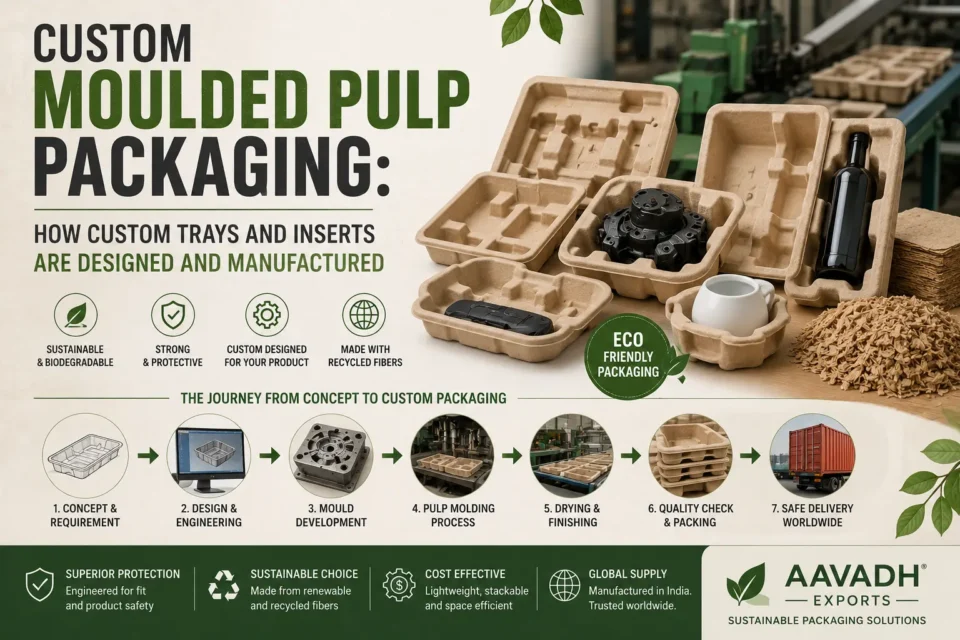
Custom-moulded inserts are designed around your product’s exact dimensions and weight distribution, typically developed through:
- Sharing product dimensions, weight, and any fragile or protruding components that need extra clearance
- Initial mould design based on those specifications
- Prototype sampling — physical samples you can test with the actual product before committing to production tooling
- Refinement based on drop-testing or transit simulation, if you have access to it
- Final mould approval and production scheduling
The upfront cost of custom tooling is higher than ordering a standard tray, but for electronics — where a single damaged shipment can cost far more than the tooling investment — the protection-per-unit case for custom moulds is usually straightforward to justify once you’re ordering at meaningful volume.
Cost & Sustainability Benefits for Electronics Brands
Beyond protection, the business case for switching includes several concrete benefits:
- Material cost stability — recycled paper pulp pricing tends to be less volatile than plastic resin, which is exposed to oil price swings that can disrupt packaging budgets
- Lower landed cost at scale — for high-volume electronics packaging runs, moulded pulp sourced directly from an experienced manufacturer is frequently price-competitive with, or cheaper than, EPS foam once full landed cost is considered
- Reduced regulatory exposure — as outlined in packaging regulations taking effect across the EU, UK, US states, and Australia through 2026, foam packaging increasingly carries compliance costs or outright restrictions that moulded pulp avoids
- Marketing and ESG value — recyclable, compostable packaging is a concrete, verifiable claim brands can use in sustainability reporting and customer-facing messaging, unlike foam, which is difficult to credibly market as sustainable even when technically recyclable
- End-of-life simplicity for your customer — moulded pulp packaging can typically go straight into standard paper recycling or compost, a meaningfully better unboxing and disposal experience than foam, which most customers don’t know how to recycle correctly
What to Look for in a Manufacturer for Electronics-Grade Packaging
Not every moulded pulp manufacturer is equipped to handle electronics packaging well — it requires more precision than a standard egg tray. When evaluating a supplier, look for:
- In-house custom mould development, so design iterations don’t require coordinating with a separate tooling vendor
- Experience with precision cavities, not just flat trays — ask to see examples of past electronics or similarly delicate custom work
- Consistent wall thickness control, since uneven drying or forming can create weak points exactly where your product needs support most
- Sample and prototype turnaround time, since electronics product cycles often move faster than food packaging timelines
- Export documentation and shipping experience to your specific market, so your packaging supply chain doesn’t become the bottleneck in your own product launch timeline
Talk to Us About Custom Electronics Packaging Inserts
Aavadh Exports develops custom moulded pulp inserts and trays for electronics, alongside our standard product range of egg trays, fruit trays, and medical disposables. If you’re evaluating a switch from foam for your product packaging, we can walk you through the mould development process and get samples in your hands to test.
Explore Our Products → Get a Quote →
📧 info@aavadhexports.com | 📞 +91 99 50 67 9838