There’s a certain magic in watching raw plant fibre transform into a finished, structured product — a solid egg tray or a smooth sheet of paper that once existed as recycled cardboard, bamboo stalks, or crop residue. But behind that transformation is a well-defined, decades-old industrial process. If you’ve ever wondered exactly how paper pulp is made, from raw material to finished moulded product, here’s the journey broken down step by step.
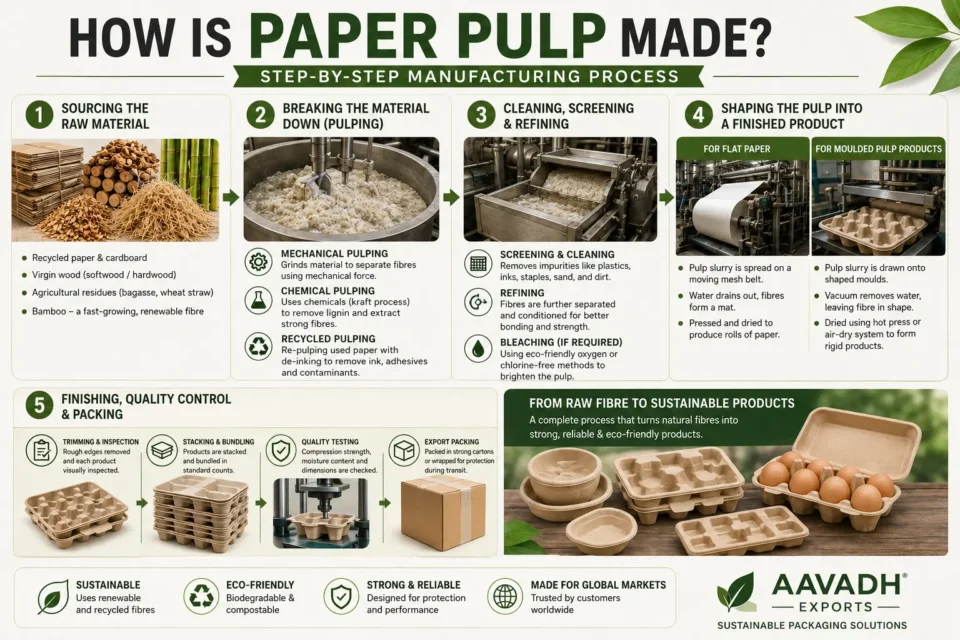
Step 1: Sourcing the Raw Material
Everything starts with fibre. Depending on the manufacturer and region, that fibre might come from several different sources:
- Recycled paper and cardboard — collected, sorted, and baled from post-consumer or post-industrial waste streams. This is the most resource-efficient source, since the fibres have already been processed once.
- Virgin wood — typically softwood or hardwood chips from managed forestry or plantation sources.
- Agricultural residues — bagasse (sugarcane waste), wheat straw, and other crop byproducts that would otherwise be burned or discarded.
- Bamboo — a fast-growing, renewable fibre source increasingly used in regions where forest land is limited.
The choice of raw material has downstream effects on everything from fibre strength to final product colour, which is why serious pulp and paper manufacturers carefully vet and blend their fibre sources rather than treating raw material as an interchangeable commodity.
Step 2: Breaking the Material Down (Pulping)
Once the raw material arrives, it needs to be broken down into individual cellulose fibres — this is pulping, and it can happen mechanically, chemically, or through a hybrid of both.
- Mechanical pulping grinds the raw material using rotating discs or drums, physically tearing fibres apart. It’s fast and cost-effective but retains lignin (the natural binding agent in plant cell walls), which can make the resulting pulp slightly weaker and prone to yellowing.
- Chemical pulping cooks the material in a chemical solution — most commonly using the kraft process — that dissolves lignin and leaves cleaner, stronger cellulose fibres behind. This produces higher-quality pulp but requires more time, energy, and careful chemical handling.
- Recycled pulping involves re-pulping used paper in large industrial pulpers, along with a de-inking stage to remove printing ink, adhesives, and contaminants before the fibre can be reused.
At the end of this stage, regardless of method, the raw material has become a thick, fibrous slurry — pulp suspended in water — ready for the next stage of processing.
Step 3: Cleaning, Screening, and Refining
Raw pulp straight out of the pulping stage isn’t ready to use yet. It typically contains impurities — bark fragments, plastic contaminants from recycled sources, staples, or unrefined fibre clumps — that need to be removed.
This stage involves passing the pulp slurry through a series of screens and cleaners that filter out unwanted material based on size and density. The pulp may also go through a refining stage, where mechanical beating further separates and conditions the fibres, improving how well they’ll bond together in the final product. For high-quality applications, bleaching may also happen here, using oxygen- or chlorine-free methods increasingly preferred by environmentally conscious paper pulp manufacturers in India and elsewhere.
Step 4: Shaping the Pulp Into a Finished Product
This is where the process branches, depending on what’s being made.
For flat paper: The cleaned pulp slurry is diluted further with water and spread thinly and evenly across a continuously moving mesh conveyor (the “wire section” of a paper machine). Water drains through the mesh, leaving behind a thin mat of interlocking fibres. This mat then passes through a series of press rollers to remove more water, followed by heated dryer cylinders that evaporate the remaining moisture, producing a continuous roll of finished paper.
For moulded pulp products (trays, packaging inserts): Instead of a flat mesh, the pulp slurry is drawn onto a shaped mould — a metal screen crafted into the exact three-dimensional form of the final product, whether that’s an egg tray, a fruit tray, or a custom protective insert. Vacuum suction pulls water through the mould, depositing an even layer of wet fibre in that shape. The moulded piece is then transferred to a drying stage — often using heated presses or hot-air tunnels — where it solidifies into a rigid, finished shape.
This moulding process is exactly how egg tray paper pulp manufacturers produce the trays that protect eggs through storage, handling, and long-distance shipping — each tray formed from a specific mould shape, dried to precise moisture content, and finished for strength and stackability. The same underlying technique, adapted to different mould shapes and wall thicknesses, is how experienced paper pulp tray manufacturers produce everything from fruit trays to cushioning inserts for electronics, all from the same basic pulp slurry described earlier in this process.
Step 5: Finishing, Quality Control, and Packing
The final stage covers everything that happens between “dried product” and “ready to ship.” This typically includes:
- Trimming and inspection — removing any rough edges and checking for structural defects, uneven walls, or moisture inconsistencies.
- Stacking and bundling — moulded products are usually nested and bundled in standardised counts for efficient storage and shipping.
- Quality testing — checking compression strength, moisture content, and dimensional accuracy against the buyer’s specifications.
- Export packing — for international orders, this includes packaging that protects the product itself during long transit, along with documentation for customs and compliance.
Reliable paper pulp packaging manufacturers treat this final stage with the same seriousness as the earlier production steps, since even a well-made product can be damaged or delayed by poor packing or inconsistent quality checks before it reaches the buyer.
Why Understanding This Process Matters
Knowing the actual steps behind pulp and paper production isn’t just interesting trivia — it’s genuinely useful if you’re evaluating suppliers. A manufacturer who can walk you through their fibre sourcing, pulping method, and moulding process with specifics — rather than vague assurances — is generally a manufacturer who has real control over product consistency and quality.
It also helps explain why pricing and lead times vary so much between suppliers. A manufacturer using recycled fibre with efficient mechanical pulping will typically have different cost and turnaround profiles than one using virgin chemical pulp with extensive bleaching and finishing.
From raw fibre to finished tray, the journey involves careful engineering at every stage — sourcing, breaking down, cleaning, shaping, and finishing. The next time you pick up an egg carton or a moulded fruit tray, there’s a genuinely intricate industrial process behind that simple, disposable-looking object — one that’s been refined over more than a century of papermaking, and adapted more recently for a world that needs sustainable, plastic-free packaging at scale.
How Long Does the Full Process Take?
For flat paper production on a continuous machine, the journey from wet pulp slurry to finished, dried paper can take just a few minutes per section of the process, since the machine runs continuously at high speed. Moulded pulp products work on a different rhythm — because each piece is formed individually on a mould and then dried as a batch, the cycle from wet-forming to fully dried, finished tray typically takes anywhere from a few hours to a full day, depending on the drying method (heated press versus hot-air tunnel) and the thickness of the product.
This is one reason production planning matters so much for buyers placing large export orders — a manufacturer needs enough mould capacity and drying infrastructure running in parallel to hit bulk order volumes within a reasonable lead time, rather than relying on a single production line working sequentially.
Frequently Asked Questions
Does moulded pulp packaging use the same machinery as flat paper production?
Answer: No. While both start from the same basic pulp slurry, flat paper uses a continuous mesh conveyor system, while moulded products use individual shaped moulds with vacuum-forming and separate drying stages — different equipment suited to different final shapes.
Can the pulping process be adjusted for different product strengths?
Answer: Yes. Fibre blend ratio, refining intensity, and wall thickness during moulding can all be adjusted to produce a stronger, more rigid product for heavier items, or a lighter, more economical product for less demanding applications.
Is the process different for recycled versus virgin fibre?
Answer: The core steps — pulping, cleaning, shaping, drying — remain the same, but recycled fibre requires an additional de-inking and contaminant-removal stage before it’s ready for use, since it’s coming from previously printed or used paper.