Automotive parts suppliers and logistics providers are increasingly turning to molded pulp packaging for replacement parts, components, and dunnage — a use case that predates most current sustainability trends, since thick-wall molded pulp has been used for auto replacement parts packaging for decades due to its cushioning and cost characteristics. This guide covers the specifications, benefits, and sourcing considerations for automotive packaging buyers.
What Is Molded Pulp Automotive Packaging?
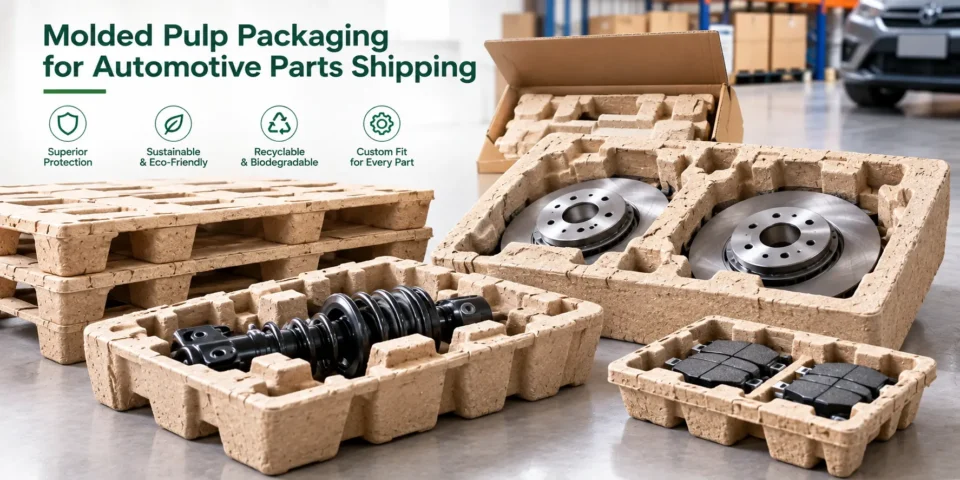
Molded pulp automotive packaging typically falls into the “thick-wall” or “slush-molded” category, with wall thicknesses of 1.5mm to 6mm, designed for support and cushioning rather than fine surface detail. Common applications include auto replacement part trays, edge protectors, engine and drivetrain component cradles, and dunnage used to stabilize parts within larger shipping containers or reusable bins.
This category sits between two other molded pulp product families covered elsewhere on our site: it shares the thick-wall manufacturing approach used for industrial pallets and dunnage, while also borrowing precision-cavity design principles from electronics packaging when a specific part — such as a sensor housing or a coated component — needs a tighter-tolerance cradle rather than a generic support tray.
Molded Pulp vs. Plastic Dunnage for Automotive Parts
| Factor | Molded Pulp | Reusable Plastic Dunnage | EPS Foam |
| Best-fit use case | Single-use/export/aftermarket parts | Closed-loop OEM supply chains | Delicate component cushioning |
| Upfront cost | Low-moderate | High (designed for reuse) | Low |
| Long-term cost (high-volume repeat use) | Higher per-shipment if reused route isn’t viable | Lower per-use after break-even | Ongoing per-unit cost, disposal liability |
| Regulatory/disposal considerations | Biodegradable, low disposal burden | Durable but eventual plastic waste | Rising foam disposal restrictions |
| Export/customs simplicity | High (no special treatment required) | N/A (typically stays in closed-loop network) | High |
| Tooling flexibility for part-specific shapes | Good, especially with transfer molding | Excellent, designed for precision reuse | Good |
For related reading on how molded pulp performs against foam for delicate components, see our comparison of molded fiber electronics packaging vs. EPS foam and moulded fibre packaging for electronics, since many of the cushioning principles for auto electronics and sensor components overlap with consumer electronics packaging.
Key Specifications for Automotive Buyers
| Specification | Why It Matters |
| Wall thickness (typically 1.5mm–6mm) | Determines cushioning capacity for part weight/fragility |
| Compression strength under stacked load | Critical for warehouse and container stacking during transit |
| Part-specific cavity tooling | Custom molds for specific part geometries reduce movement/damage |
| Moisture and oil resistance | Relevant for parts with residual lubricants or exposure to humid transit conditions |
| Compatibility with existing bin/rack systems | Ensures packaging integrates with warehouse and line-side material handling |
| Export documentation/compliance | No ISPM-15 requirement, unlike wood-based dunnage alternatives |
| Static-sensitive part handling | Relevant for parts with embedded electronics or sensors |
Why Automotive Suppliers Are Switching
- Avoiding wood treatment requirements for export. Like industrial pallets, wood-based dunnage requires ISPM-15 heat treatment certification for international shipment — molded pulp alternatives avoid this compliance step for cross-border auto parts shipments, which can meaningfully shorten customs clearance times.
- Cost efficiency for aftermarket and export parts. Unlike OEM closed-loop supply chains that justify reusable plastic dunnage investment, aftermarket parts distributors and exporters shipping to markets without a return logistics network benefit more from single-use, lower-upfront-cost molded pulp packaging.
- Adequate cushioning for mid-weight components. Thick-wall molded pulp has a long track record specifically for auto replacement parts packaging, offering sufficient shock absorption for components like housings, covers, brackets, and similar mid-weight parts without the cost of engineered foam inserts.
- Sustainability alignment for Tier 2/3 suppliers. As OEMs push sustainability requirements down their supply chains, smaller component suppliers are evaluating molded pulp packaging as a lower-cost way to demonstrate packaging sustainability improvements without large capital investment in reusable systems.
- Reduced warehouse and shipping volume. Molded pulp dunnage typically nests more efficiently than rigid plastic bins when empty, reducing return-shipping and warehouse storage costs even in supply chains that do reuse some packaging components.
Who Buys This Product
- Automotive aftermarket parts distributors and exporters
- Tier 2/3 automotive component suppliers
- Auto parts e-commerce retailers
- Logistics and freight companies handling automotive component shipments
- Packaging distributors serving the automotive supply chain
- Auto parts remanufacturers shipping cores and rebuilt components
Export Considerations for International Buyers
Automotive parts packaging buyers should provide precise part dimensions, weight, and any fragility considerations (e.g., electronic sensors, coated surfaces) when requesting custom tooling, since generic thick-wall trays may not provide adequate part-specific protection. Review our guide on how molded pulp packaging is manufactured to understand tooling and production lead times for custom cavity designs, and our buyer’s guide to importing molded pulp packaging from India for the general import and documentation process.
For total cost comparison against wood dunnage (factoring in ISPM-15 treatment costs) or reusable plastic systems, see our guides on import duties and tariffs and calculating landed cost.
Frequently Asked Questions
Is molded pulp packaging strong enough for heavier automotive components?
Thick-wall molded pulp is suitable for mid-weight components like housings, covers, and brackets; very heavy components (e.g., engine blocks, transmissions) typically require wood, metal, or reusable plastic dunnage instead.
Does molded pulp automotive packaging require ISPM-15 treatment for export?
No, molded pulp is not subject to ISPM-15 wood packaging treatment requirements, which can simplify customs clearance compared to wood-based dunnage.
Can molded pulp trays be custom-molded to fit specific part geometries?
Yes, custom cavity tooling can be designed around specific part shapes to minimize movement and improve protection during transit, similar to custom electronics packaging tooling.
Is molded pulp suitable for parts with oil or lubricant residue?
Standard molded pulp has limited oil resistance; buyers should discuss moisture/oil-resistant coating options with their supplier if parts will have residual lubricants during packaging.
Can molded pulp dunnage be used inside reusable plastic bins as an inner liner?
Yes, this is a common hybrid approach — a molded pulp insert provides part-specific cushioning inside a larger reusable plastic bin or container, combining the benefits of both material types.
Matching Packaging to Part Criticality
Not every automotive part shipped in molded pulp packaging carries the same risk profile if damaged in transit. A cosmetic trim panel and a sensor-equipped control module both might travel in thick-wall molded pulp trays, but the tolerance for even minor damage is very different between the two. Buyers should categorize parts by criticality and damage sensitivity before finalizing packaging specifications, reserving tighter-tolerance custom cavity tooling for higher-value or more fragile components, while using simpler generic thick-wall trays for lower-risk, lower-value parts where a fully custom mold wouldn’t be cost-justified.
This tiered approach also helps control tooling investment. Rather than commissioning custom molds for every SKU in a parts catalog, many exporters start with a small number of standardized tray sizes that cover the majority of part dimensions by weight and shape category, reserving fully custom tooling for the specific high-value or high-fragility items that genuinely require it. This keeps packaging costs proportionate to part value across a large and varied automotive parts catalog.
Get a Quote
Looking to source molded pulp packaging for automotive parts shipping or aftermarket distribution? Contact Aavadh Exports for custom tooling consultation, samples, and export pricing.