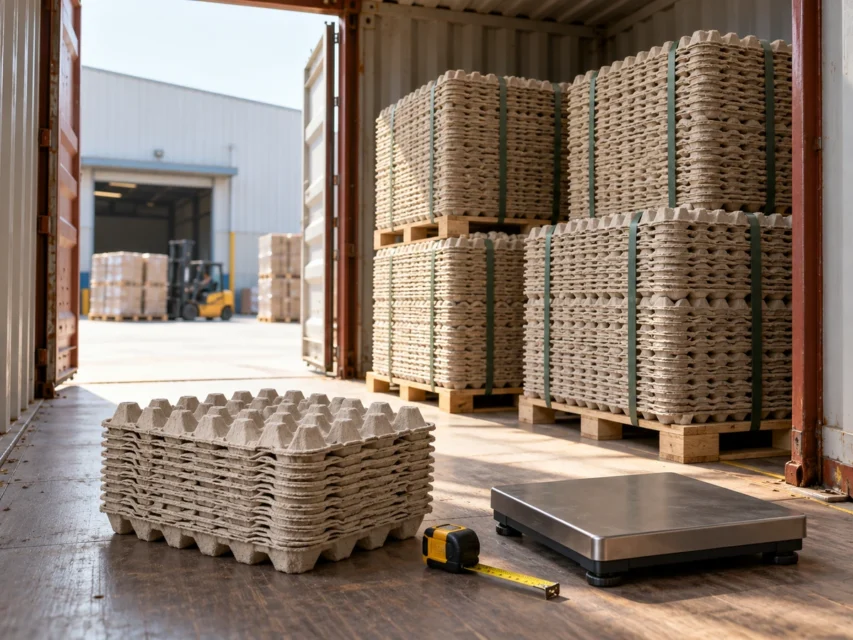
How many egg trays fit in a 20ft container? Buyers often want one number they can use to compare suppliers. Unfortunately, capacity is not a fixed property of the container alone.
The answer depends on the tray design, how tightly empty trays nest, bundle dimensions, protective packing and the loading method. A quantity from another supplier’s shipment may be unsuitable for your order.
This guide explains egg tray container loading for empty trays. Shipping eggs in filled trays is a different planning exercise, with different weight, product-care and handling requirements.
Use the calculations to check a proposal, then confirm the final quantity against a measured packing specification and the booked equipment.
Start with the right shipping unit
Do not multiply one tray’s external volume by the number ordered. Empty trays commonly nest, so each additional tray adds much less height than the first.
The useful shipping unit is the finished bundle, carton or pallet that will actually be loaded. Measure it after normal packing, including wrapping, straps and any protective components.
Record three things together: trays per shipping unit, external dimensions and gross weight. A container quantity is difficult to verify when one of those is missing.
For the product specification behind the calculation, see our egg tray sizes and cell configurations guide.
Understand nesting pitch and bundle height
Nesting pitch is the height added by each additional nested tray under a defined packing condition. It can change with geometry, packing pressure and variation between trays.
A useful approximation is:
Bundle height = First tray height + (Number of trays − 1) × Nesting pitch + Packing allowance.
Suppose a hypothetical tray starts at 50 mm high and each additional tray adds 4 mm. A 100-tray stack would measure approximately 446 mm before external packing.
That is an illustration, not a specification. Measure completed production bundles rather than relying only on a theoretical pitch or compressing samples beyond safe handling limits.
Calculate bundle volume
Convert all dimensions to metres before calculating:
Bundle volume = Length × Width × Height.
For a hypothetical bundle measuring 0.60 m × 0.40 m × 0.50 m, volume is 0.12 cubic metres.
If that bundle holds 100 trays, its nominal packed volume per tray is 0.0012 cubic metres. Use this number for preliminary comparisons between packing proposals.
Check that the dimensions and tray count refer to the same bundle. Mixing a small sample stack’s dimensions with a different commercial bundle quantity can substantially overstate loading capacity.
Use container specifications as boundaries
Maersk’s published dry-container equipment information lists a 20ft standard example with internal dimensions of approximately 5.898 m × 2.352 m × 2.393 m and nominal volume of 33.2 cubic metres.
Those figures are useful for an initial model. The actual equipment, door opening, usable space and permitted weights must be confirmed for the shipment.
Do not divide nominal container volume by bundle volume and treat the result as a guaranteed quantity. Rectangular units rarely use every available cubic metre, and handling or restraint arrangements may need additional space.
The loaded units must also pass through the door safely.
Worked example: a conservative rectangular layout
Use the hypothetical 0.60 m × 0.40 m × 0.50 m bundle above, holding 100 trays. Assume floor loading, one fixed orientation and no pallets.
| Direction | Calculation | Complete units |
|---|---|---|
| Along container length | 5.898 ÷ 0.60 | 9 |
| Across container width | 2.352 ÷ 0.40 | 5 |
| In vertical layers | 2.393 ÷ 0.50 | 4 |
| Total bundles | 9 × 5 × 4 | 180 |
| Total trays | 180 × 100 | 18,000 |
This is one illustrative layout, not a manufacturer loading commitment or an optimised arrangement. Rotating units or using a different bundle can change the result.
Check stability, stacking limits, clearances and loading access before accepting even a geometrically possible arrangement.
Check weight independently of volume
Container planning must satisfy both space and weight constraints. Calculate the cargo weight rather than assuming lightweight trays cannot exceed a limit.
Net tray weight = Number of trays × Weight per tray.
If the illustrative 18,000 trays each weigh 65 g, their combined net weight is 1,170 kg. Add straps, wrapping, cartons, pallets and other packing to obtain gross cargo weight.
The 65 g figure is an assumption, not a specification for Aavadh Exports trays.
Confirm the booked container’s payload, carrier restrictions and applicable transport limits. Follow the required verified gross mass process rather than relying only on an informal estimate.
Compare floor loading and pallet loading
Floor loading may allow a different quantity from pallet loading, but the decision also affects receiving labour and handling equipment.
For pallets, include the pallet’s own dimensions, height and weight. Check overhang, load stability and whether the complete unit can pass through the door. Confirm relevant requirements if wood packaging is used.
Ask the receiving warehouse how it will unload the goods. A denser load is not automatically cheaper if it creates disproportionate manual handling or damage.
Compare both proposals using usable trays received, total logistics cost and the time required to put stock away.
Do not confuse empty-tray nesting with loaded stacking
Empty trays can nest into one another. Trays holding eggs cannot use the same nesting arrangement. Therefore, an empty-tray container quantity says nothing reliable about how many eggs can be shipped.
Likewise, a tall empty bundle does not prove a safe height for stacks of filled trays. Loaded stacking depends on the approved tray, egg sizes, outer packaging and transport conditions.
Keep separate specifications for shipping empty packaging and using that packaging in your poultry operation.
For operational background, read our paper pulp egg packaging guide alongside the product-specific handling instructions agreed with your supplier.
Calculate freight per usable tray
Once the proposed quantity is credible, divide the applicable logistics cost by the number of usable trays expected at receipt.
For example, hypothetical freight of $1,800 spread over 18,000 trays contributes $0.10 per tray. If a different verified packing arrangement increases the quantity to 20,000 at the same freight, the contribution becomes $0.09.
Do not assume freight remains unchanged when weight, equipment, handling or route changes. Obtain a current quotation for each realistic option.
Our landed-cost guide helps combine freight with the other costs needed to compare complete offers.
Request a loading plan before confirming quantity
Ask for bundle count, trays per bundle, dimensions, gross weight, proposed orientation and a loading sketch. Identify any pallets, protective materials or restraint requirements.
During loading, record actual counts and packing condition. Reconcile the packing list with the purchase order and container plan. Keep photographs where useful for shipment records.
For recurring purchases, confirm that the packing specification remains unchanged before reusing an old loading quantity.
Share your preferred equipment, receiving method and order volume with Aavadh Exports. Ask for an order-specific packing and loading proposal rather than relying on a generic number found online.
Frequently asked questions
How many egg trays fit in a 20ft container?
There is no universal quantity. It depends on measured nested bundles, trays per bundle, loading orientation, equipment dimensions and handling constraints.
Can I calculate capacity using cubic metres alone?
Use volume for an initial estimate, then verify a physical layout. Door access, unusable gaps, stacking limits and weight can reduce the practical quantity.
Does a heavier tray always increase freight?
Not necessarily. Charges depend on the shipment and pricing basis. Compare actual packed volume, gross weight and the forwarder’s quotation for each option.
Will a 40ft container hold twice as many trays?
Do not assume an exact multiplier. Calculate a separate arrangement using the selected equipment, bundle dimensions and permitted loading conditions.
What is the most important measurement to request?
The external dimensions of a finished shipping unit together with its tray count and gross weight. Those linked measurements make the loading calculation verifiable.