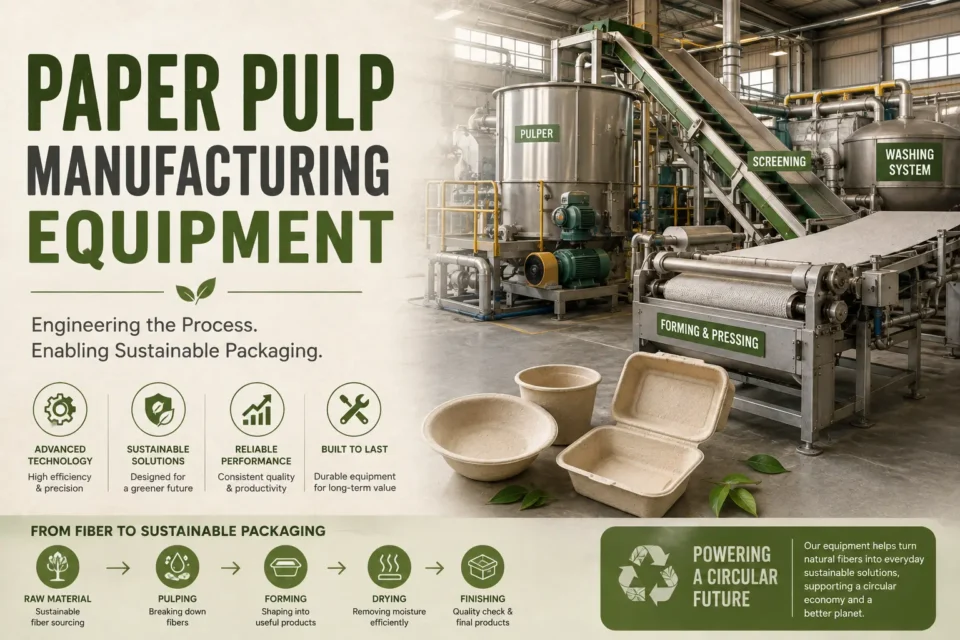
Behind every egg tray, protective insert, or molded fiber product is a chain of specialized equipment, each handling a specific stage of transforming raw paper or wood material into a finished packaging product. Whether you’re a business researching your supplier’s capabilities or simply curious about the manufacturing side of the industry, understanding the key equipment involved gives useful context on how production capacity, quality, and cost are determined. Here’s an overview.
1. Hydra-Pulper (Pulping Machine)
The process typically begins with a hydra-pulper — a large tank fitted with a rotating blade or rotor that mixes raw material (recycled paper, cardboard, or wood fiber) with water, mechanically breaking it down into a wet, fibrous slurry. This is the equipment equivalent of the “pulping” stage, and its capacity is often a key indicator of a manufacturer’s overall production scale.
2. Pulp Refiners
For manufacturers using virgin wood fiber or requiring more refined pulp consistency, refiners further process the pulp slurry, adjusting fiber length and consistency to improve moldability and final product strength. This equipment is less common in smaller molded packaging facilities that rely primarily on recycled paper input, which typically needs less refining.
3. Molding Machines (Forming Equipment)
This is the equipment that defines molded pulp packaging as a category. Molding machines use vacuum suction to draw wet pulp slurry onto mesh molds shaped like the final product — egg tray cavities, protective insert contours, or custom shapes — pulling water through the mesh while building up a layer of fiber in the mold’s shape.
There are generally two configurations:
- Rotary molding machines — molds are arranged on a rotating drum or wheel, allowing continuous, high-volume production; commonly used for standard products like egg trays
- Reciprocating (shuttle) molding machines — molds move back and forth between forming and transfer stations, often used for more complex or custom-shaped products requiring greater precision
4. Transfer and Pressing Equipment
After initial forming, many production lines transfer the wet molded shape to a secondary mold for final shaping and pressing. This pressing stage compacts the fiber, removes additional moisture, and improves the product’s final rigidity and surface consistency — particularly important for products requiring tighter dimensional tolerances, like electronics packaging inserts.
5. Drying Equipment
Once formed and pressed, molded pulp products need to be dried before they’re ready for trimming and packing. Drying methods vary significantly by production scale:
- Natural air drying — molded products are placed on racks or trays and left to air dry, a lower-cost method common for standard products like basic egg trays, though it requires more space and time
- Heated drying tunnels — molded products pass through a mechanized tunnel with controlled heat, significantly speeding up production and improving moisture consistency, typically used by higher-capacity manufacturers
The choice between these methods directly affects a manufacturer’s production speed, consistency, and, ultimately, lead times for bulk orders.
6. Trimming and Finishing Equipment
After drying, automated or semi-automated trimming equipment removes excess material around the edges of each molded piece, ensuring a clean, consistent final shape. For products requiring additional finishing — printing, coating, or surface treatment — separate finishing equipment is used at this stage.
7. Quality Control and Inspection Systems
Many manufacturers, particularly those focused on export markets, incorporate inspection stages — sometimes automated, often manual — to check for consistency in thickness, shape, and structural integrity before packing. This equipment and process investment is a meaningful indicator of a manufacturer’s reliability for bulk and international orders.
Why Equipment Matters When Choosing a Supplier
The type and scale of equipment a manufacturer operates directly affects what they can realistically produce — production volume, consistency across large orders, ability to develop custom molds, and turnaround time. A manufacturer running rotary molding machines with heated drying tunnels, for example, will typically offer faster, more consistent bulk production than one relying primarily on natural air drying, though the latter may still be perfectly suitable for smaller or less time-sensitive orders.
If you’re evaluating suppliers for a significant order — especially for export — it’s reasonable to ask about their equipment setup and production capacity, since this affects both lead time and consistency at scale.
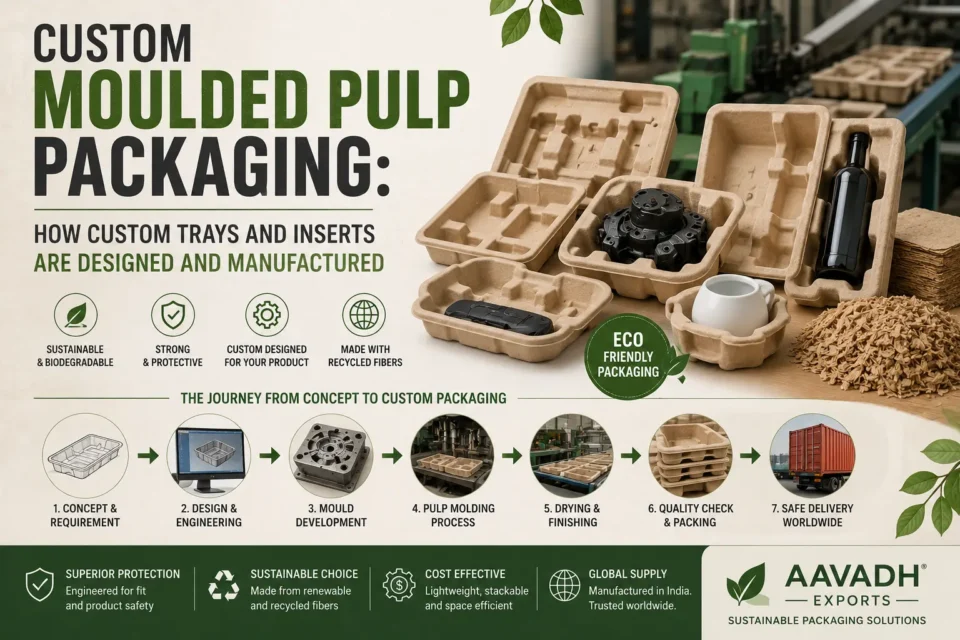
To understand how this equipment fits into the full manufacturing process from start to finish, see our detailed guide on how molded pulp packaging is manufactured.
At Aavadh Exports, our production is built around export-grade consistency and volume — supporting bulk orders of egg trays, electronics packaging, medical and healthcare trays, and footwear and consumer goods packaging, along with custom molded pulp packaging built on custom mold development.
Frequently Asked Questions
What is a hydra-pulper used for? It’s the machine that mixes raw paper or wood material with water and mechanically breaks it down into pulp slurry — the starting point of molded pulp production.
What’s the difference between rotary and reciprocating molding machines? Rotary machines use a continuously rotating mold arrangement for high-volume standard production, while reciprocating (shuttle) machines move molds between stations, often used for more complex or custom-shaped products.
Does drying method affect product quality? Yes — heated drying tunnels generally produce more consistent moisture content and faster turnaround than natural air drying, which can affect uniformity across large orders.
Why does equipment scale matter for bulk orders? Larger, more automated equipment setups generally support higher production volume and more consistent quality across large orders, which is particularly important for export and recurring bulk supply needs.
Can the same equipment produce both standard and custom molded products? To some extent, yes, though custom products typically require new mold tooling designed specifically for that product’s shape, even if the same core forming and drying equipment is used.