If you’ve read about the pulp and paper industry, you’ve almost certainly come across the term “pulping mill” or “pulp mill.” For anyone outside the industry, it’s easy to picture this as just another paper factory — but a pulping mill is actually a specific, highly specialized type of facility with its own distinct processes, equipment, and role in the broader supply chain. Here’s a clear breakdown of what it is and how it operates.
What Is a Pulping Mill?
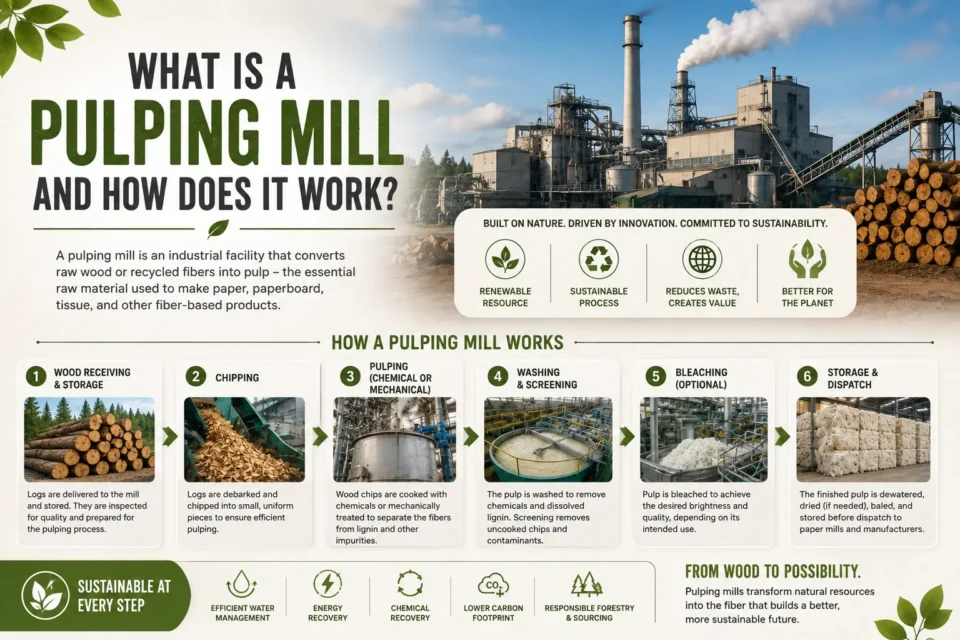
A pulping mill is an industrial facility that converts raw material — typically wood, wood chips, or recycled paper — into pulp: the fibrous, cellulose-based material used to manufacture paper, cardboard, and molded packaging products. It’s distinct from a paper mill, which takes finished pulp and presses it into sheets of paper — although many large facilities today operate combined pulp-and-paper mills that handle both stages on the same site.
The Core Stages of a Pulping Mill
1. Wood/Material Receiving and Preparation
Raw material — logs, wood chips, sawmill residue, or recycled paper — arrives at the mill and is prepared for processing. For virgin wood pulp, this involves debarking logs and chipping them into small, uniform pieces to maximize surface area for the pulping process. For recycled input, this stage focuses on sorting and removing contaminants like plastics, staples, and other non-fiber material.
2. Pulping
This is the mill’s core function — separating cellulose fiber from the surrounding material, either mechanically (grinding wood fiber apart) or chemically (dissolving the lignin binding fibers together, most commonly through the kraft/sulfate process). For recycled paper, this stage involves re-pulping — breaking down existing paper products back into fiber form, along with de-inking to remove printing residue.
3. Washing and Screening
Once pulped, the fiber mixture is washed to remove residual chemicals (in chemical pulping) or contaminants (in recycled processing), then screened to remove any remaining oversized particles or impurities, ensuring a consistent, clean fiber output.
4. Bleaching (Where Applicable)
For pulp destined for higher-grade, brighter paper products, an additional bleaching stage removes residual lignin and coloring compounds. Pulp intended for products like molded packaging trays typically skips extensive bleaching, since these products don’t require the same visual brightness standards.
5. Chemical Recovery (For Chemical Pulping Mills)
A defining feature of large-scale chemical pulping mills — particularly kraft process mills — is the chemical recovery system. Spent cooking chemicals are processed through a recovery boiler, regenerating usable pulping chemicals and significantly reducing both cost and environmental impact. This recovery infrastructure is a major reason why chemical pulp mills tend to be large-scale, capital-intensive operations.
6. Pulp Output — Sheets, Rolls, or Direct Feed
Depending on the mill’s setup, finished pulp is either dried and baled into sheets for shipment to separate paper or packaging manufacturers, or fed directly into an on-site paper machine or molded packaging production line if the facility handles multiple stages of production.
How This Connects to Molded Pulp Packaging
Molded pulp packaging manufacturers — the companies producing egg trays, protective inserts, and similar products — don’t always operate full-scale pulping mills themselves. Many source pre-processed recycled pulp or work with recycled paper directly, running a more compact, in-house re-pulping process specifically suited to molded packaging production, rather than the large-scale chemical recovery infrastructure found in major pulp mills producing virgin fiber for the broader paper industry.
This distinction matters for buyers: a molded pulp packaging manufacturer’s production facility looks and operates quite differently from a large industrial pulp mill, even though both ultimately work with the same core material.
Why Pulping Mills Are Capital-Intensive Operations
Large pulping mills, particularly those using virgin wood and chemical processes, require significant infrastructure — chemical recovery boilers, wastewater treatment systems, and large-scale material handling equipment — making them substantial capital investments typically operated by major industrial paper companies rather than smaller packaging manufacturers.
This is part of why the broader pulp and paper industry tends to be dominated by large, established players, while the downstream molded packaging manufacturing industry — which relies more heavily on already-processed recycled pulp — has a lower barrier to entry and includes a wider range of manufacturers, from large industrial operations to specialized regional exporters.
Understanding the Supply Chain
For businesses sourcing molded pulp packaging, understanding this distinction helps clarify where your supplier sits in the broader supply chain. Most molded packaging manufacturers are not operating pulping mills themselves — they’re purchasing or re-processing recycled paper pulp and focusing their expertise on mold design, forming, and finishing. This is a meaningful difference from companies further upstream that manage virgin wood sourcing and large-scale chemical pulping.
To understand how that raw pulp material — regardless of which type of facility produced it — eventually becomes finished packaging, see our guide on how molded pulp packaging is manufactured. For the broader industry context, our overview of the pulp and paper industry covers global trends and scale.
At Aavadh Exports, we specialize in molded pulp packaging manufacturing — working with quality-controlled recycled fiber to produce egg trays, electronics packaging, medical and healthcare trays, and footwear and consumer goods packaging.
Frequently Asked Questions
What’s the difference between a pulp mill and a paper mill?
A pulp mill converts raw material into pulp fiber, while a paper mill presses finished pulp into sheets of paper. Many large facilities combine both operations on a single site.
Do molded pulp packaging manufacturers operate their own pulping mills?
Most don’t operate large-scale industrial pulping mills; instead, they typically work with recycled paper, running a more compact re-pulping process specifically suited to molded packaging production.
Why are pulping mills so capital-intensive?
Large mills, especially those using chemical processes, require significant infrastructure — including chemical recovery systems, wastewater treatment, and large-scale material handling — making them major industrial investments.
What raw material do pulping mills typically use?
Mills use virgin wood (logs or chips), sawmill residue, recycled paper, or agricultural fibers like bagasse and wheat straw, depending on the type of pulp being produced.
Does the pulping mill process affect molded packaging quality?
Indirectly, yes — the fiber quality produced at the pulping stage affects the strength and consistency of any downstream product, including molded packaging made from that pulp, whether sourced directly or through recycled paper.